In depth: air quality monitors explained
Expert Reviews put the View Plus first, and still called it expensive
Expert Reviews' December 2024 roundup is the broadest independent source for this page, and it covers three of the five models. Stuart Andrews ran two or more units side by side on a living room shelf in a three-bedroom house for about a week, then exposed them to paint fumes, smoke, deodorant spray and humidifier moisture in a smaller room to see how fast each reacted. He tried smart features through an Amazon Echo or an Android phone with Google Assistant. The View Plus was the top pick, with praise for the hub function and the app, and a note that at about £250 it is expensive.
The roundup also lists monitors outside our set, which explains some omissions. The Amazon Smart Air Quality Monitor, at about £70, tracks carbon monoxide, PM2.5 and VOCs but has no display and needs Alexa. The Eve Room, at about £88, tracks VOCs only and works with Apple HomeKit. The Temtop M10i, at about £100, tracks PM2.5, VOCs and formaldehyde but its battery lasts about six hours. We could not read Amazon's or Currys's pages automatically, so we could not verify stock for the first two and did not add them.
T3's 2022 review of the View Plus adds a second voice. Duncan Bell used it for about two weeks, put the retail price at £260, and found it more cautious than two purifiers in his home. His complaints are specific: it flags a problem without saying what to do, PM1 shows only on the web dashboard, and the app relies on colour. Those are the things to weigh against the fact that it is the only model here with PM2.5.
The Aranet4 Home has the weakest test trail and the strongest sensor claims
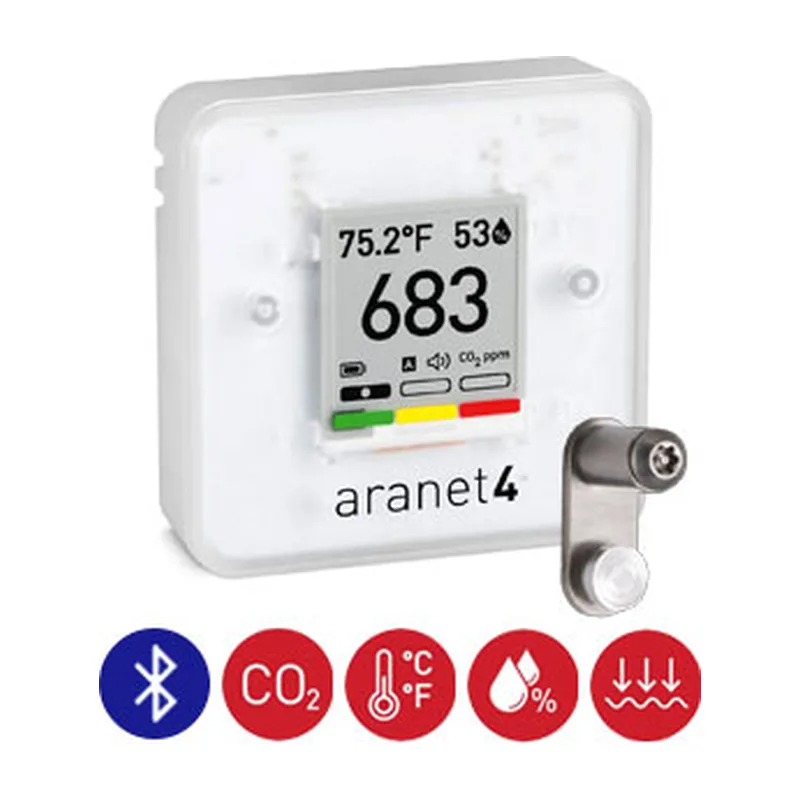
The Aranet4 Home is the model with the thinnest independent trail among our top three. Mighty Gadget's James Smythe used it and gave it 78%, in a review first published in 2020 and updated in July 2026. He liked the design, the readable screen and the CO2 focus, found the app basic but clear, and wanted better smart home integration, noting that Homey was the only third-party option he found and that the lack of IFTTT or API access limits its appeal. He left the factory calibration and did not check readings against a reference instrument.
HouseFresh, updated in October 2026, ranks the Aranet4 first as the best portable monitor. It cites an NDIR sensor, a stated accuracy of ±30 ppm plus 3% of reading and up to four years on batteries, and notes the lack of PM2.5 and VOC sensing. That page reports no head-to-head measurements and relies largely on manufacturer specifications, so we use it as background and not as a test.
Set against the TFA, the Aranet4 has the clearer accuracy claim and the lower price, while the TFA has an independent grade and an alarm. If you value a documented lab result, the TFA's Stiftung Warentest grade is the stronger evidence; if you value a stated sensor and years of battery life, the Aranet4 is.
The Wave Plus and View Plus differ by one sensor, a screen and about 70 pounds
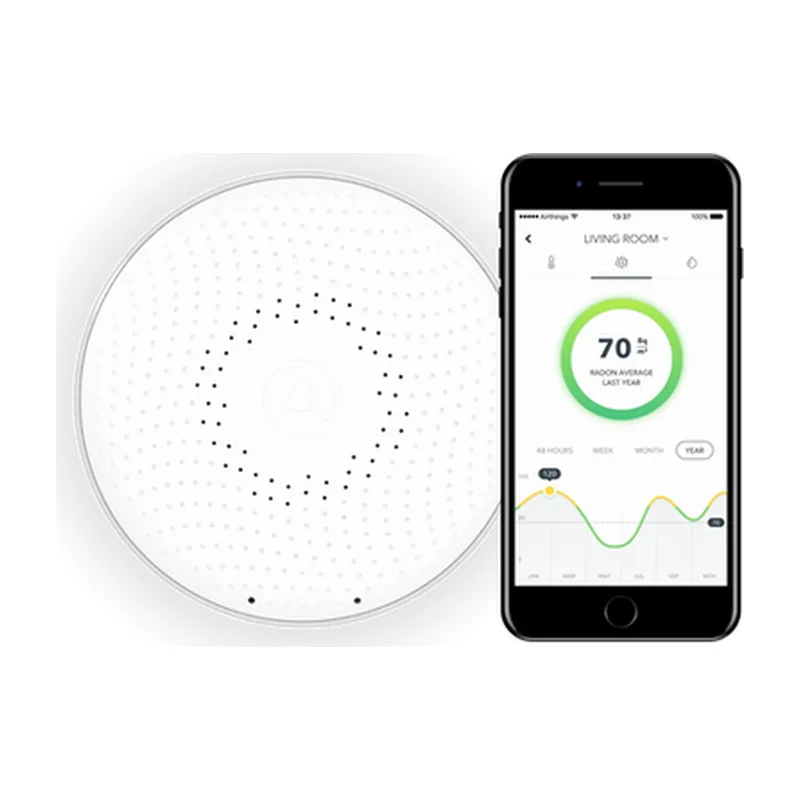
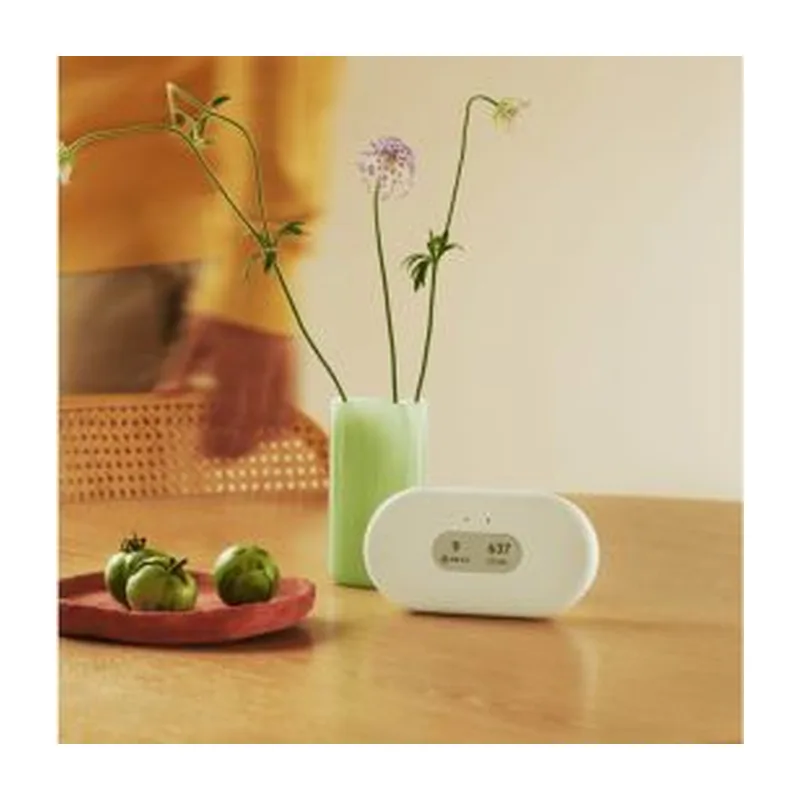
Both Airthings models report radon, CO2, VOCs, temperature, humidity and air pressure. The View Plus adds PM2.5, a 2.9 in e-ink screen that stays on, 2.4 GHz Wi-Fi with a hub function for other Airthings devices, and a motion-activated indicator. The Wave Plus has a colour ring and two AA batteries, and the retailer we link quotes a 12-month guarantee, while Airthings offers the View Plus a free five-year extension if you register it within 30 days.
At £189 against £259, the difference is £70. The Wave Plus reviews we used date from 2020 (Tech Advisor) and 2024 (Expert Reviews). Expert Reviews called the Wave Plus one of the most comprehensive monitors it looked at and the View Plus its top pick, which is the same order our comparison produces, with the particle sensor and screen as the reasons.
Choose the Wave Plus if PM2.5 and a screen are not worth the extra, and the View Plus if you cook often on gas, live near traffic, or want the reading visible without opening an app. Tech Advisor's cooker example is the Wave Plus's own caveat: it saw TVOC and CO2 rise after cooking, but with no particle sensor it could not show the smoke.
Stiftung Warentest's German CO2 assessment helps for one model and says nothing about the rest
Stiftung Warentest published its assessment of 26 CO2 meters and traffic-light devices on 22 December 2021. The results table sits behind a paywall, which we did not use. The free pages show a quality grade of good (1.8) for the TFA AirCO2ntrol 5000, and the free overview flags the Airthings View Plus as the best smart CO2 measurement without showing a grade.
The free text is useful for how to use any CO2 monitor. It puts placement at about head height, around 1.5 m in classrooms and offices, and away from an open window or a poorly ventilated corner. It says one meter can serve several rooms if you measure one after another. It gives 21 to 22 degrees Celsius for offices and 40 to 60% relative humidity as the comfort ranges. It also says fine dust and VOC functions were not part of the assessment, so it says nothing about the View Plus's PM2.5 or the Airthings VOC sensors.
The Aranet4 is not mentioned on the free page, so there is no Stiftung Warentest evidence for it. The assessment is German and five years old. Use it as one data point on the TFA, not as a verdict on the category.
Buying guide: choosing the right air quality monitor
A CO2 reading tells you about stale air, not about pollution
CO2 is what you breathe out, so a CO2 monitor is really a stale air monitor. Stiftung Warentest's free article on CO2 meters is clear about the limits: the devices cannot detect viruses, they show how much exhaled air is in a room, and its rule of thumb is to keep the average under 1,000 ppm and to air the room at once above 2,000 ppm. That is advice from a German consumer body, not UK guidance, so treat it as one reference point rather than a standard.
Two of the five monitors here are built for exactly this reading. The Aranet4 Home and the TFA AirCO2ntrol 5000 both name an NDIR sensor and state something about accuracy. The View Plus and Wave Plus also measure CO2, but as one of seven or six readings, and neither Airthings page we read gives an accuracy figure. The Wave Mini has no CO2 sensor at all.
The sensor matters in practice. Mighty Gadget's reviewer saw the Aranet4 climb to nearly 1,500 ppm while he sat in a room in the evening, which is half as much again as that 1,000 ppm rule of thumb. A monitor without a CO2 sensor would not have shown that reading. If you were picking the Wave Mini for a home office, this is the gap you would be accepting. A CO2 monitor does not fit if your worry is cooking smoke or traffic: neither CO2 specialist measures particles.
Particles are the one reading only a single model here can give you
The View Plus is the only monitor in this comparison with a PM2.5 sensor. Expert Reviews notes that the Wave Plus lacks one and says that may matter in busy traffic areas, and Tech Advisor made the same point in 2020, calling the Wave Plus less compelling as a general air quality monitor because it does not measure particulate matter. That is the clearest dividing line in the comparison, and it costs £70 between those two Airthings models, which also buys the View Plus's always-on screen.
A separate monitor can disagree with the sensors built into other devices. T3's reviewer found the View Plus rated his air as fair, mainly because of VOCs, a day after a smoky pizza oven session, while two air purifiers in the same space both reported excellent air. He took it as a warning that the monitor flags problems the purifiers do not, and also as something that can cause unnecessary worry. If your real aim is cleaner air rather than a reading, our air purifier comparison covers the models that do the cleaning.
Skip the PM2.5 sensor if you want to know about ventilation only. The Aranet4 Home costs £118.61 less than the View Plus and answers that question with a battery that lasts years.
Radon is a feature, and only two of these monitors have it
The View Plus and the Wave Plus both report radon. The Aranet4, the TFA and the Wave Mini do not. If radon matters to you, the Wave Plus is the cheaper route at £189 against £259, and Expert Reviews rated it one of the most comprehensive monitors it looked at. HouseFresh ranks the View Plus sixth of seven overall but names it the pick for radon.
Radon readings need patience. Tech Advisor describes a week-long calibration on the Wave Plus during which data is shown but may be less accurate, We did not assess radon risk by area, so check a radon map for your address before paying for the sensor.
A radon sensor does not fit a rented flat you plan to leave next year, or any home where you have no interest in the number: the other three monitors cost less and report what you can act on in a day, such as CO2 and humidity.
Stated accuracy is rarer than you would expect, and the numbers do not line up
Only two of the five pages we read state a CO2 accuracy. Duomo quotes the Aranet4 at ±30 ppm or ±3% of reading, while HouseFresh writes it as ±30 ppm plus 3% of reading. At 1,000 ppm, 3% is 30 ppm, so the first version gives ±30 ppm and the second ±60 ppm. Both are tighter than HouseFresh's ±50 ppm plus 3% for the View Plus, which would give ±80 ppm at the same reading, and which we could not find on Airthings' own page.
The TFA's figure, ±7% of reading above 3,000 ppm, is the least useful of those stated. At 4,000 ppm it allows 280 ppm either way, but it says nothing about the 400 to 1,500 ppm range where you will mostly use it. A partial claim is still better than none, which is why the TFA scores above the Airthings pair on this criterion and below the Aranet4.
Treat all of these as manufacturer claims. HouseFresh says its own accuracy figures are mostly manufacturer specifications, and Mighty Gadget's reviewer left the Aranet4 on factory calibration without checking it against a reference. If you need certified accuracy for a workplace record, none of the pages we read cites a certificate, so this comparison cannot tell you which monitor would pass.
Battery life decides where a monitor can sit
The Aranet4 Home is stated at up to four years on two AA batteries, the longest in the comparison. The View Plus runs up to two years on six AA batteries or on USB-C, the Wave Mini over two years on three AA batteries on Bluetooth, and the Wave Plus 12 to 15 months on two AA batteries according to Expert Reviews. The TFA has no battery option in the pages we read: it comes with a USB adapter and a micro-USB cable, and its cable length is not stated.
That changes where you can put each one. A bedside shelf or a school wall with no socket nearby suits the Aranet4 or the Mini; a desk beside a plug suits the TFA. Battery claims vary with how often the device reports, so Airthings says the View Plus figure depends on the sensor interval and the router. Expert Reviews also covered a model outside this set, the Temtop M10i, whose battery lasts about six hours, which is a reminder to read the line before you buy.
Bluetooth-only monitors such as the Aranet4 and the Mini send readings to your phone when it is in range. The Aranet4 pages we read describe no Wi-Fi, so if you want to check a reading while you are away, the View Plus with Wi-Fi is the model here that fits.
You will look at the one you can read at a glance
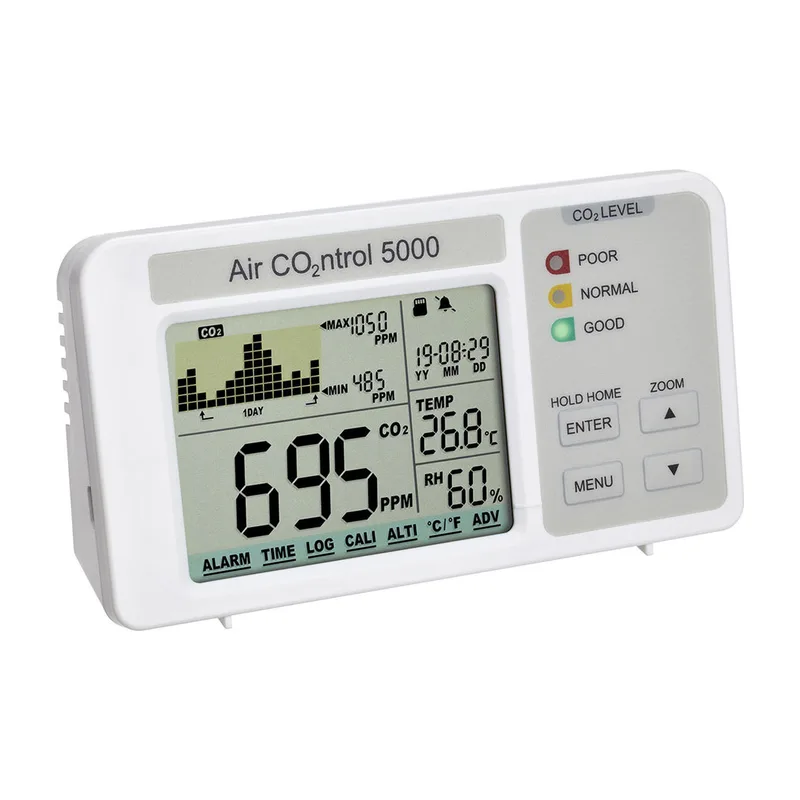
Displays split the field. The Aranet4 shows the exact CO2 figure on an e-ink screen with a colour indicator, and Mighty Gadget's reviewer liked that he did not need the app. The View Plus has a larger always-on e-ink screen that shows up to four values you choose, plus a motion-activated glow. The TFA uses a traffic-light LED, a graph of past values and an audible alarm you can set. The Wave Plus and the Wave Mini have no screen: one has a colour ring and the other a glow you summon by waving a hand over it.
No screen means a colour has to carry the message. Tech Advisor found the Wave Plus ring turned red when humidity fell to 24% but did not say which factor was off, and T3 noted that the View Plus app signals quality by colour alone, which the writer found hard as a colour-blind reader. If you share the room with someone who has colour vision difficulties, favour the models that show numbers.
A ring or glow monitor does not fit a shared office where you want a number or a sound. For a classroom, the TFA's sounding alarm is the only alert described on the pages we read.
Think about who will read it and when. In a child's bedroom the reader is an adult checking in the evening, and a screen that stays on, as on the View Plus and the Aranet4, takes one glance. The Wave Mini needs a wave of the hand before it shows anything, which suits a hallway shelf better than a bedside table.
Logging is what turns a gadget into a record
The TFA is the clearest logger. It writes CSV files to a micro SD card, over 1 million records, at intervals from 5 to 600 seconds. At the fastest interval a million records is about 58 days of continuous data, and at the slowest interval about 19 years, so the card is unlikely to be the limit. That suits a landlord or a teacher who wants to show how ventilation changed after a window was fixed.
The others are less open. The Aranet4 stores history on the device and loads it over Bluetooth, a few seconds at a time according to Mighty Gadget. HouseFresh says View Plus data cannot be exported. Tech Advisor found that detailed trends on the Wave Plus need the desktop dashboard. None of the pages we read describes a CSV export for the Airthings models.
If you only want a daily glance, logging is a feature you will not use. Pay for it only if you plan to compare weeks, not minutes.
The best air quality monitor is the one that answers your question
Decide what you are trying to find out. For stale air in a bedroom or office, the Aranet4 Home at £140.39 is the best air quality monitor in this comparison for that single job, and the TFA adds an alarm and logging for £25.56 more. For particles, radon and CO2 together, the View Plus at £259 is our top pick. For radon and CO2 without particles, the Wave Plus at £189. For a VOC and mould-risk signal at the lowest price, the Wave Mini at £69.
The per-reading cost is a quick check on value: about £37 for the View Plus, about £31.50 for the Wave Plus and about £35 for the Aranet4, all counted from the readings listed on their pages. The Mini and the TFA come out cheaper or dearer depending on what you count, because the Mini includes a calculated score and the TFA's date and time are not pollutant readings.
Check delivery before you commit, because the pages differ. Airthings says shipping is calculated at checkout, Smart & Secure Centre quotes next-working-day delivery subject to availability on the Wave Plus, Rapid Online quotes dispatch within four working days for the TFA, and Duomo's page mentions next-day delivery. Tempcon and Radon Protection UK do not state a delivery time. Stock matters as well: Netatmo's UK page showed its indoor monitor out of stock, and Rapid Online listed the TFA Coach on a four-week back order, which is why neither is in this comparison.
None of these is a certified instrument, and none replaces a smoke or carbon monoxide alarm. They show trends in a room and nothing more.
Frequently asked questions
What is the best air quality monitor in the UK?
In our comparison the Airthings View Plus is the best air quality monitor overall, because it reports seven readings including PM2.5, CO2 and radon, and Expert Reviews made it its top pick in 2024. It costs £259. For CO2 alone, the Aranet4 Home at £140.39 is the cheaper choice.
Do I need a CO2 monitor or a full air quality monitor?
It depends on what you want to know. A CO2 monitor such as the Aranet4 Home or the TFA AirCO2ntrol 5000 tells you how much exhaled air is in a room, which is a ventilation signal. A full monitor such as the View Plus adds particles, VOCs and radon, but costs £118.61 more than the Aranet4.
What CO2 level should I aim for indoors?
Stiftung Warentest's free article gives a rule of thumb of keeping the average under 1,000 ppm and airing the room at once above 2,000 ppm. That is a German consumer body's guidance, not an official UK limit. Mighty Gadget's reviewer saw the Aranet4 reach nearly 1,500 ppm in a room in the evening.
Can an air quality monitor detect viruses?
No. Stiftung Warentest says CO2 meters cannot detect viruses. They show how much exhaled air is in a room, which is an indirect signal about ventilation. None of the manufacturer or retailer pages we read claims that any of these monitors detects viruses.
How accurate are home CO2 monitors?
Only two pages state a figure. Duomo quotes ±30 ppm or ±3% of reading for the Aranet4 Home and Tempcon quotes ±7% of reading above 3,000 ppm for the TFA. HouseFresh lists ±50 ppm plus 3% for the View Plus. No reviewer here checked these monitors against a reference instrument.
Which of these monitors measures radon?
Two do: the Airthings View Plus and the Airthings Wave Plus. The Wave Plus is £70 cheaper but has no PM2.5 sensor and no screen. Tech Advisor describes a week-long calibration period on the Wave Plus, during which readings may be less accurate.
Do air quality monitors need Wi-Fi?
Not all do. The Aranet4 Home and the Wave Mini use Bluetooth to a phone, and the TFA logs to an SD card and mentions no app. The Wave Plus pages we read describe a wireless app and an online dashboard without naming the protocol. The View Plus uses 2.4 GHz Wi-Fi, Bluetooth LE and SmartLink, and can act as a hub for Airthings Wave devices when powered by USB-C and Wi-Fi.
How long do the batteries last?
Stated figures vary. The Aranet4 Home is up to four years on two AA batteries, the Wave Mini over two years on three, the View Plus up to two years on six, and the Wave Plus 12 to 15 months according to Expert Reviews. The TFA runs on USB power and has no battery option in the pages we read.
Where should I put an air quality monitor?
Stiftung Warentest suggests about head height, around 1.5 m in classrooms and offices, and not directly in front of an open window or in a corner with poor airflow. It also says one meter can serve several rooms if you measure one after another. Follow the manufacturer's placement notes for the radon sensors.
Is the cheapest monitor worth buying?
The Airthings Wave Mini at £69 is the cheapest here, but it has no CO2 sensor. It reports VOCs, temperature, humidity and a calculated mould risk score. Buy it for that signal, not as a CO2 monitor. For CO2 the cheapest model here is the Aranet4 Home.
Is the Aranet4 Home better than the View Plus?
It depends on the job. The Aranet4 Home has the clearer CO2 accuracy claim, up to four years of battery life and a price of £140.39, but it reports only four readings. The View Plus reports seven, including PM2.5 and radon, has a larger screen and Wi-Fi, and has the stronger independent coverage, which is why it ranks first.
Can I export the data from these monitors?
The TFA writes CSV files to a micro SD card, over 1 million records. The Aranet4 stores history on the device and loads it over Bluetooth. HouseFresh says View Plus data cannot be exported, and Tech Advisor says detailed Wave Plus trends need the desktop dashboard.