In depth: trail running shoes explained
Two labs measured the same shoe and got different lug depths
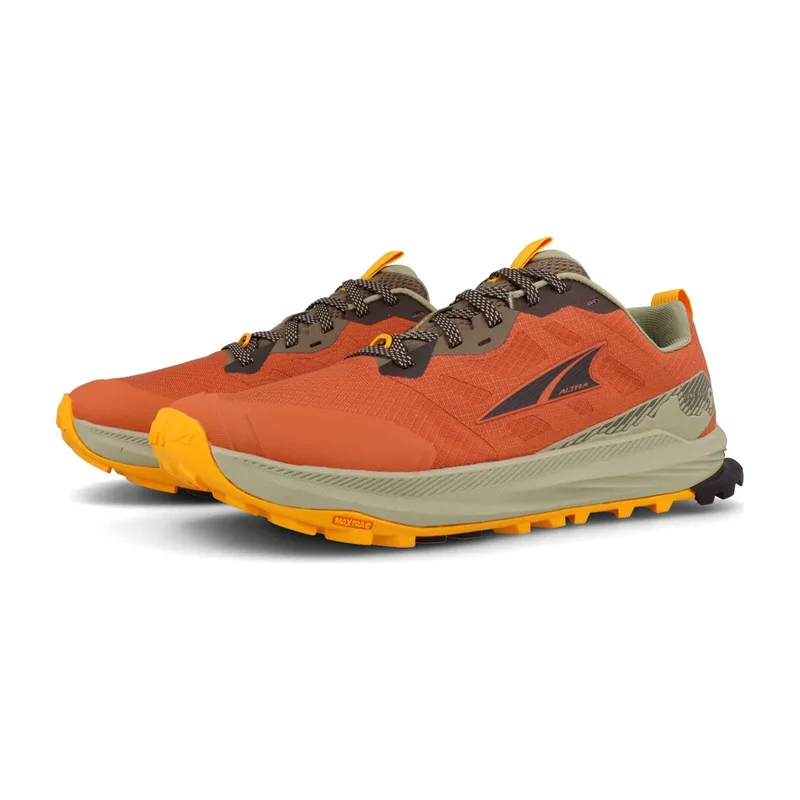
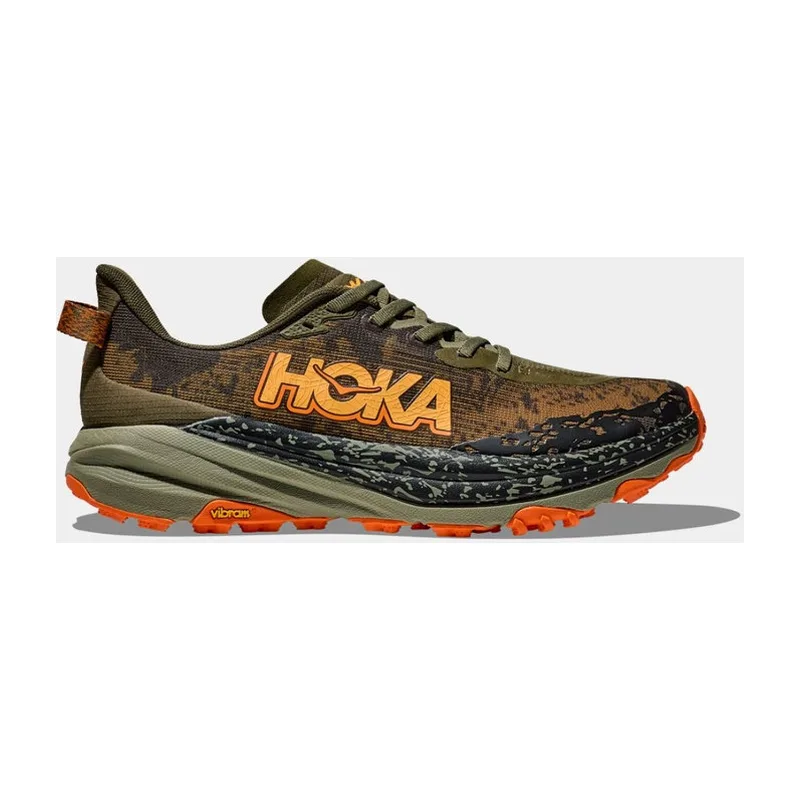
RunRepeat and OutdoorGearLab both reviewed the Hoka Speedgoat 6, and their numbers do not match. RunRepeat measured the lugs at 4.0 mm and OutdoorGearLab at 4.6 mm, a 0.6 mm gap. For the Altra Lone Peak 9 the readings are 3.8 mm and 4.0 mm, though RunRepeat measured the Vibram-outsole 9+, so that pair is not a like-for-like comparison. For the Speedgoat 6 the most likely explanation is a different measuring method or a different spot on the sole, but neither source explains the gap, so this page lists both figures and does not average them.
Weights differ for a more visible reason. RunRepeat's 278 g for the Speedgoat 6 and OutdoorGearLab's 10.58 oz (about 300 g) are both per shoe, but the second is in a US men's 10.5 and the first does not state a size. The Lone Peak 9 shows a similar pattern, at 309 g in RunRepeat against 11.29 oz (about 320 g) in OutdoorGearLab, although RunRepeat weighed the 9+. The OutdoorGearLab weights are about 21 g to 22 g heavier, which is consistent with a larger size.
The scoring systems also differ. OutdoorGearLab gave the Speedgoat 6 and Lone Peak 9 the same overall score of 74, but the two shoes scored differently inside it: traction 7.8 against 6.7, foot protection 8.0 against 6.5, and stability 7.1 against 8.0. Overall totals hide those trade-offs, which is why this page scores each criterion separately and weights grip and comfort most heavily.
The Cascadia 19 and Speedgoat 6 are close on paper and apart in the outsole
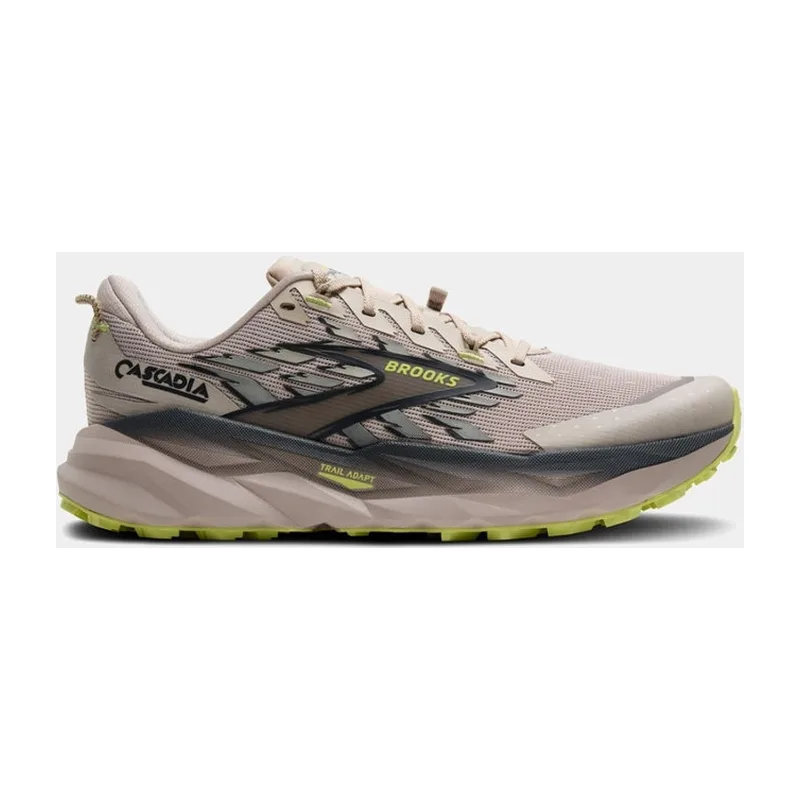
RunRepeat's own scores for the two are within one point, 85 for the Cascadia 19 and 84 for the Speedgoat 6. The gap in this ranking comes from the criteria RunRepeat does not summarise. The Cascadia 19 weighs 306 g against 278 g, a 28 g difference per shoe, has a 7.8 mm drop against 4.9 mm, and costs £21 more. Its forefoot traction reading of 0.51 is below RunRepeat's 0.69 average, though RunRepeat still lists traction among its strengths.
Where the Cascadia 19 wins clearly is outsole wear: 0.7 mm against the Speedgoat 6's 1.4 mm in the same abrasion check. A runner who cares about getting several hundred kilometres from one pair on abrasive trail, and who has a narrow to medium foot, will find that a better trade than the Hoka's lower weight. A runner who values a lighter, more agile ride on mixed ground, and is willing to replace the shoes sooner, will prefer the Speedgoat 6.
There is a fit difference as well. The Cascadia 19's 72.5 mm toebox is the narrowest of the seven and the Speedgoat 6's 73.0 mm is the second narrowest, so neither is a wide-foot shoe. Both sit on one side of the Lone Peak 9 at 85.3 mm. The first decision for most buyers is therefore width, then grip, and the rest follows.
The two Inov-8 shoes are a separate bet from the other five
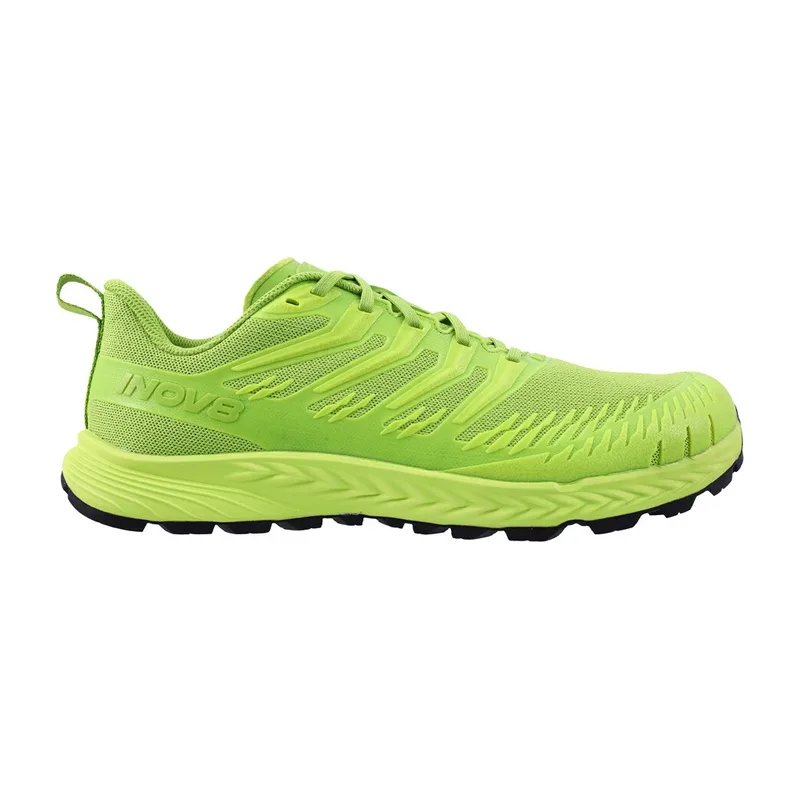
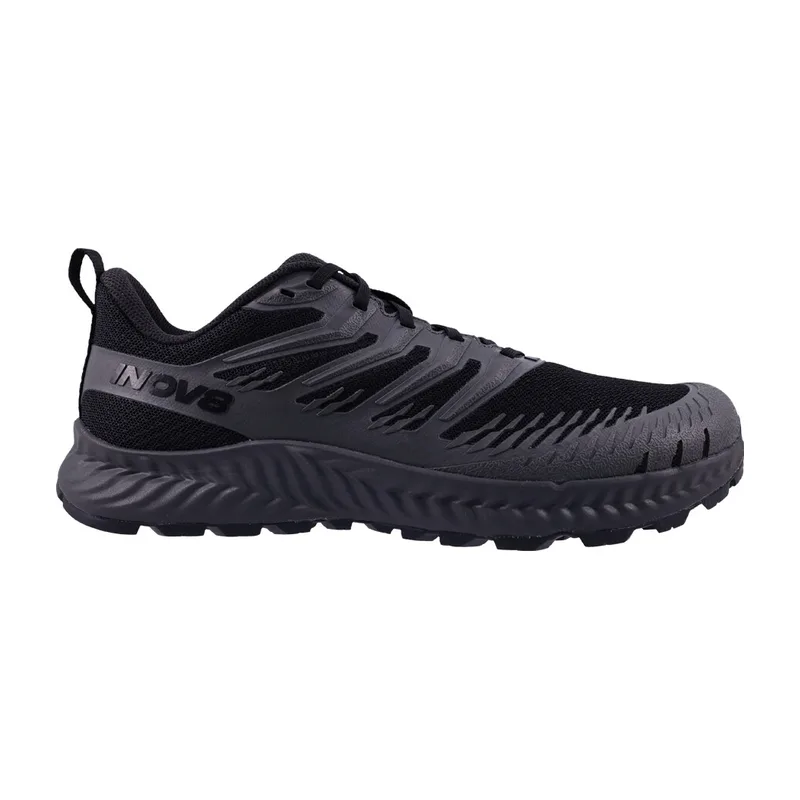
The TrailFly V2 and TrailFly Speed V2 are both recent releases and both reviewed by RunRepeat in September 2026. They share a wide toebox (80.0 mm and 79.7 mm), good airflow (5 and 4 out of 5) and Gravel sub-scores of 80 and 82. They differ in cushioning, with a heel stack of 34.0 mm against 25.5 mm, and in price: £116.99 against £83.99, a gap of £33.
RunRepeat's traction measurements favour the cheaper shoe, at 0.62 against 0.48 forefoot friction, although RunRepeat notes the Speed V2 is weak on wet surfaces and gave it the lower Technical sub-score, 30 against 38. For dry, firm trails the cheaper shoe is the better value. For a runner who wants a roomy, cushioned shoe that doubles as a hiking shoe, the TrailFly V2 is the one RunRepeat recommends, with the caveat that its grip is underwhelming for the price.
Neither shoe challenges the top three in this comparison, because they are specialised: dry ground, wide feet, warm weather. They are the right shoes for some people and the wrong shoes for anyone running steep mud, and that is how they should be read, not as weaker alternatives to the Speedgoat 6.
The cheapest shoe is sixth because price carries 15% of the score
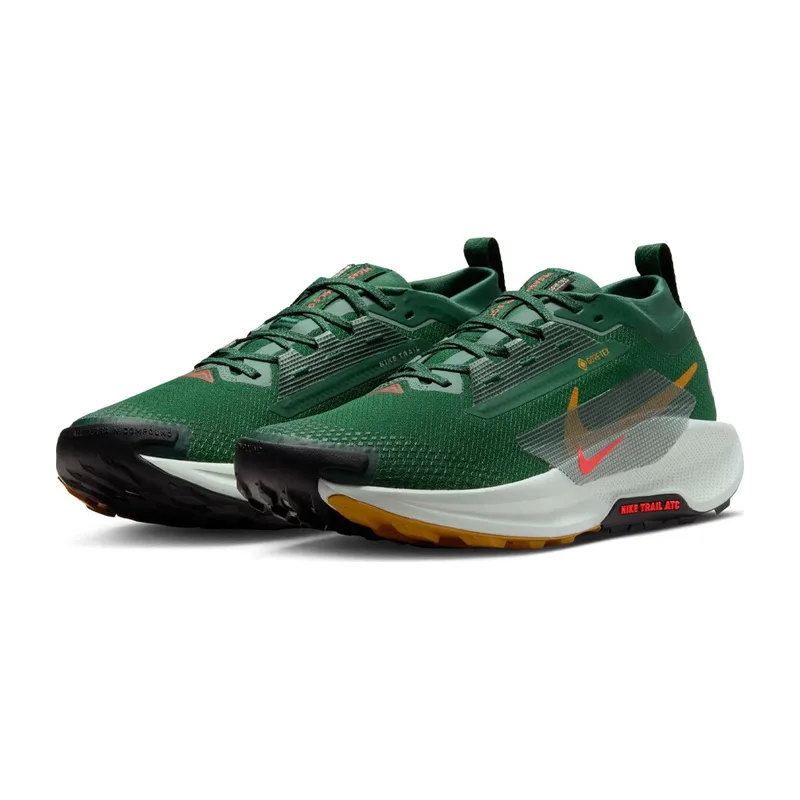
The Nike Pegasus Trail 5 GTX scores highest of all on price, at £72.49, and it is the only waterproof shoe. But the price criterion is 15% of the weighting, and on the heavier-weighted criteria it scores low: RunRepeat says grip falls short on technical terrain, calls out ankle instability for heel strikers and rates breathability and heel padding at 1 out of 5 each. Those weaknesses add up to a placement below the Cascadia 19 and Speedcross 6, both of which cost more.
The arithmetic shows how little the price gap is worth. The Pegasus Trail 5 GTX costs £2.50 less than the Lone Peak 9, which ranks second. A reader choosing between them is paying that sum for a waterproof membrane and 28 g less weight (281 g against 309 g) but receiving lower traction evidence, weaker durability and much poorer ventilation.
That is the right shoe for one buyer: someone who runs on firm, wet paths in winter, wants a waterproof shoe, and has caught the Nike at its discounted price. For anyone else, the sixth place is the honest verdict of the evidence.
Buying guide: choosing the right trail running shoe
Deep lugs win in mud and lose almost everywhere else
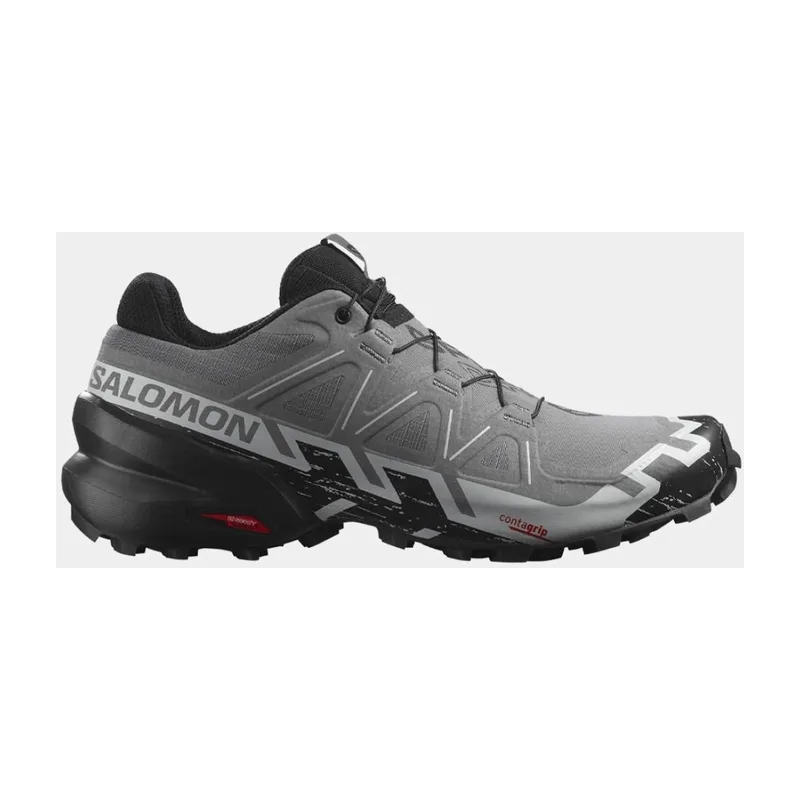
The Salomon Speedcross 6 shows the trade most clearly. RunRepeat measured its lugs at 5.8 mm against a 3.5 mm category average, and its Technical sub-score is 89 out of 100, which describes steep, loose and muddy ground. The same page gives it a Gravel sub-score of only 40. Deep lugs flex and squirm on hard-packed paths, so the shoe that is best in a bog is not the one you want for the road section to the trailhead.
The Inov-8 TrailFly Speed V2 sits at the other end. Its lugs are 3.5 mm, equal to the average, and it scored 82 for Gravel but only 30 for Technical. Between the two sit the Hoka Speedgoat 6 at 4.0 mm in RunRepeat's lab (OutdoorGearLab put it at 4.6 mm) and the Cascadia 19 and Lone Peak 9 at 3.8 mm. A 2.3 mm spread in lug depth is small to read on a spec sheet and large underfoot.
Lug depth is only half of grip. The rubber compound matters too: RunRepeat records the Speedcross 6 outsole as one of the hardest it has measured at 93.9 HC, while the Speedgoat 6 uses Vibram Megagrip. If your runs are mostly dry gravel and forest tracks, paying for deep lugs buys nothing, and the Lone Peak 9 or Cascadia 19 will do the job with a calmer ride. If you run fells, bog and winter fields, put the Speedcross 6 first on the list despite its weaknesses elsewhere.
A shoe's drop decides which runners it is built for
The measured heel-to-toe drop in this group runs from 0.0 mm on the Altra Lone Peak 9 to 14.1 mm on the Salomon Speedcross 6, and the number is a design choice rather than a quality score. RunRepeat says the Speedcross 6 is ideal for heel strikers and not suitable for midfoot or forefoot strikers, while describing the Lone Peak 9 as the go-to for zero-drop runners. Both are fair descriptions of a shoe built around one landing pattern.
Between the extremes, the Speedgoat 6 measures 4.9 mm, the TrailFly Speed V2 5.4 mm, the Cascadia 19 7.8 mm, the Pegasus Trail 5 GTX 8.3 mm and the TrailFly V2 8.7 mm. Several brands quote figures that differ from the lab: Salomon claims 10 mm for the Speedcross 6 against a measured 14.1 mm, and Brooks claims 6.0 mm for the Cascadia 19 against 7.8 mm. RunRepeat's reviewer also says the Speedcross 6 feels closer to 8 to 10 mm than the lab number, so treat any single figure as approximate.
If you are moving from a conventional road trainer, the middle of the range is the sensible place to look, and the Cascadia 19 and Pegasus Trail 5 GTX are the closest to that feel. The Lone Peak 9 is a poor first trail shoe for anyone who has never run on a flat platform, and the Speedcross 6 is a poor choice if you land on your forefoot. RunRepeat even names ankle instability for heel strikers as a con of the Pegasus Trail 5 GTX, which shows how much the landing pattern changes the verdict on a single shoe.
A waterproof membrane keeps rain out and sweat in
The Nike Pegasus Trail 5 GTX is the only waterproof shoe in this comparison, and RunRepeat rates its Gore-Tex membrane as high quality. The same review scores its breathability at 1 out of 5 and notes very little ventilation. The Inov-8 TrailFly V2 is its mirror image, with 5 out of 5 for airflow and no membrane.
That choice is about where you run. On wet, cold paths in winter, a shoe with a membrane keeps ankles drier on a stream crossing that only reaches the sole, which is the situation RunRepeat points to when it calls the Pegasus Trail 5 GTX suited to winter and all-day use. In summer, or for any run with deep puddles where water comes over the top, the membrane makes less difference and the lack of ventilation counts against you. A mesh shoe that drains and dries can be the better answer to a wet day than one that stays damp for hours.
The Brooks Cascadia 19 sits in the middle among the non-waterproof shoes: RunRepeat records breathability of 65 against a 71 average and a drying potential of 46%. The Speedcross 6 and Speedgoat 6 are denser, at 1 and 2 out of 5. If you run hot, the TrailFly V2 and TrailFly Speed V2 (4 out of 5) are the shoes to compare. If you want one shoe for both a wet January and a dry July, the answer is a ventilated shoe and a second pair of waterproof socks, not the Pegasus Trail 5 GTX.
Toebox width matters more than the length on the box
RunRepeat measures the width across the big toe, and the results here span 12.8 mm: 72.5 mm for the Cascadia 19, 73.0 mm for the Speedgoat 6, 75.2 mm for the Speedcross 6, 76.5 mm for the Pegasus Trail 5 GTX, 79.7 mm for the TrailFly Speed V2, 80.0 mm for the TrailFly V2 and 85.3 mm for the Lone Peak 9. The category average is 74.3 mm. In other words, three of the seven are narrower than a typical trail shoe, and the Lone Peak 9 is 11.0 mm wider than it.
Width and sizing are two different problems. RunRepeat's fit vote of 196 readers says the Speedgoat 6 runs slightly small, and the Pegasus Trail 5 GTX is also described as running slightly small, while 67 votes call the Speedcross 6 true to size. A shoe that runs small and is narrow, like the Speedgoat 6, needs a wide version or a half-size up. Hoka and Altra both sell wide fits of these models according to RunRepeat, so check the retailer's listing before you assume the standard width is your only option.
The pairing to avoid is a wide foot and the Cascadia 19. RunRepeat cons its narrow toebox in the verdict, and the 12.8 mm gap to the Lone Peak 9 is not something lacing can fix. Equally, a narrow foot in a Lone Peak 9 will rely on OutdoorGearLab's note that the upper fit is loose. Try them on in the afternoon, when feet are largest, and walk downhill in the shop if the retailer lets you.
Lacing changes how a shoe holds the foot as much as width does. RunRepeat praises the Speedcross 6's QuickLace lockdown and a secure fit on the TrailFly Speed V2, while OutdoorGearLab calls the Lone Peak 9's upper loose and RunRepeat cons the thin upper padding on the Pegasus Trail 5 GTX. A loose upper on a wide shoe like the Lone Peak 9 can be tightened, but a thin upper cannot be padded, so read those notes as part of the fit decision and not as side comments.
Outsole wear and upper wear are not the same number
RunRepeat's abrasion check drags a rotary tool across the outsole and records how much rubber is removed. The Cascadia 19 lost 0.7 mm, the Lone Peak 9+ (a Vibram-outsole variant) 0.8 mm, the TrailFly V2 and TrailFly Speed V2 0.9 mm each, the Pegasus Trail 5 GTX 1.0 mm, the Speedcross 6 1.2 mm and the Speedgoat 6 1.4 mm, against a 0.9 mm average. The Speedgoat 6 therefore lost twice as much rubber as the Cascadia 19 in the same check.
The upper tells another story. RunRepeat gave the Speedgoat 6 toebox and heel padding 4 out of 5 each, but the Pegasus Trail 5 GTX only 3 out of 5 for the toebox and 1 out of 5 for heel padding, and the Speedcross 6 2 out of 5 for heel padding. A shoe can outlast its outsole or the reverse. For a runner who wears down the heel first, the padding score is the better guide.
None of these figures is a mileage. RunRepeat gives a measurement of wear in a lab, not a number of kilometres, and a shoe used mostly on tarmac connectors will lose rubber faster than one used on soft ground. They are a relative ranking. If you plan a long ultra-distance build, the Cascadia 19 is the one with the best measured outsole wear, but at £106.89 it costs £21 more than the Speedgoat 6, and that gap pays for a second pair at the end of the shoe's life only if the Hoka's outsole really wears out first.
Last season's shoe is usually the better buy, if your size is left
The Hoka Speedgoat 6 has already been replaced: Sportsshoes lists the Speedgoat 7 men's at £130.49, reduced from £144.99, on the date of checking. The Speedgoat 6 is £85.89 at Runners Need, which is £10.90 above the Lone Peak 9 and well below the newer Hoka. This page assesses only the Speedgoat 6, because a review of one version does not cover the next one and the Speedgoat 7 has no independent review among the sources gathered here.
Clearance stock has a catch. The Salomon Speedcross 6 was listed at £69.99 at Sportsshoes but sold out, while Cotswold Outdoor had it in stock at £97.95, which is £22.96 more than the Lone Peak 9. The Nike Pegasus Trail 5 GTX at £72.49 sits against a listed RRP of £144.99, so it is on sale at about half price, and a price like that may not last. Check stock in your size at the checkout, not just on the product page.
There is one limit to the bargain argument. A cheap shoe that is wrong for your foot is not a bargain, and the Pegasus Trail 5 GTX is the clearest example: it is the cheapest in the group and still sixth, because grip, breathability and heel padding all rank low. Price makes up 15% of the weighting here and the other 85% is what the shoe does on the ground.
Men's and women's versions are different shoes, and the evidence stops at the men's page
Every shoe in this comparison is the men's version. Brands tune the last, heel and cushioning differently for women's models, so a measurement made on a men's shoe does not carry over. RunRepeat and OutdoorGearLab both review men's and women's versions of several of these shoes separately, which is a good sign of how different they are. If you want the women's shoe, treat the rankings here as a guide to the model family only, and check for a separate review of your exact version.
The same applies to size. RunRepeat does not always say which size it weighed, and OutdoorGearLab weighs a US men's 10.5. On the Speedgoat 6, that gives 278 g in one lab and 10.58 oz in the other, which converts to roughly 300 g in a larger size. You should compare weights between shoes within one source, not between sources. If you mainly walk rather than run, ProductPick's comparison of women's walking shoes covers a different job and a different set of models.
A last check before you buy is the return policy. A shoe that fits in the shop on a carpet can feel different on a long descent, and the retailers linked here are the ones that had the exact model in stock on 21 November 2026, so the listings may move. If a shoe does not suit you, the best-ranked alternative in the same width is a better next try than a different brand in the same price band.
Frequently asked questions
What are the best trail running shoes in 2026?
Our top pick among the best trail running shoes is the Hoka Speedgoat 6 at £85.89 from Runners Need. OutdoorGearLab scored its traction at 7.8 out of 10 and foot protection at 8.0, and RunRepeat measured it at 278 g per shoe. The Altra Lone Peak 9 is the best value and the better pick for wide feet.
Which trail running shoes are best for mud?
The Salomon Speedcross 6 has the deepest lugs of the seven at 5.8 mm in RunRepeat's measurements, and RunRepeat lists quick mud shedding among its strengths. Its Technical sub-score is 89 out of 100. It is less suited to hard paths, where its Gravel sub-score is only 40.
Are trail running shoes different from road running shoes?
Yes, mainly in the outsole and upper. The shoes here have lugs from 3.5 mm to 5.8 mm in RunRepeat's measurements and uppers built to resist abrasion from rock and roots, which a typical road shoe does not need. That makes trail shoes grippy on soft ground and noticeably less smooth on tarmac.
Do I need waterproof trail running shoes?
Only if you run wet, cold paths in winter. The Nike Pegasus Trail 5 GTX is the one waterproof model here, with a Gore-Tex membrane that RunRepeat rates highly, but its ventilation scored 1 out of 5. A ventilated shoe such as the Inov-8 TrailFly V2 (5 out of 5) drains and dries instead.
Which trail shoe is best for wide feet?
The Altra Lone Peak 9, which RunRepeat measured at 85.3 mm across the big toe against a 74.3 mm average, and which also comes in a wide version. The two Inov-8 shoes are next at about 80 mm. The Brooks Cascadia 19 is the narrowest at 72.5 mm and the one to avoid if your feet are wide.
How much should I spend on trail running shoes?
The seven shoes here cost between £72.49 and £116.99, and the second-ranked Lone Peak 9 is £74.99. The top pick costs £85.89. Price is not a reliable guide to quality here: the dearest shoe, the TrailFly V2, ranks last.
Is the Hoka Speedgoat 6 still worth buying now the Speedgoat 7 is out?
It is if you find it at a discount in your size. Sportsshoes lists the Speedgoat 7 at £130.49, reduced from £144.99, and the Speedgoat 6 is £85.89 at Runners Need. This page has no independent review of the Speedgoat 7, so it cannot say how the two compare.
How long do trail running shoes last?
No source used here gives a mileage. RunRepeat measures outsole wear in a lab, and the Cascadia 19 lost the least rubber at 0.7 mm against 1.4 mm for the Speedgoat 6. That makes the Cascadia 19 the best evidence of outsole life, though it says nothing about the upper or midsole.
Should I size up in trail running shoes?
It depends on the shoe. RunRepeat's fit votes say the Hoka Speedgoat 6 (196 votes) and the Nike Pegasus Trail 5 GTX run slightly small, while 67 votes call the Salomon Speedcross 6 true to size. A half size up can suit the first two if you wear thick socks, but try the shoe on late in the day before committing, and check the return policy.
Which is the lightest trail running shoe in this comparison?
The Hoka Speedgoat 6 and the Inov-8 TrailFly V2 tie at 278 g per shoe in RunRepeat's measurements. The Nike Pegasus Trail 5 GTX follows at 281 g, then the TrailFly Speed V2 at 286 g, the Speedcross 6 at 296 g and the Cascadia 19 at 306 g. The Lone Peak 9 is the heaviest at 309 g, 31 g more than the lightest.
Can I use women's trail shoes if I take a smaller size in men's?
This page covers men's versions only, and the measurements and reviews quoted do not apply to women's models, which are separate shoes. If you are choosing a women's shoe, look for a review of that exact version. Do not assume a men's weight, width or drop will match.
Are the lab figures the same as customer reviews?
No. RunRepeat and OutdoorGearLab measure and review shoes they have bought, which tells you about weight, lug depth and wear in a controlled way. Customer ratings tell you about long-term fit and returns. This page uses the lab sources only, and none of the placements rests on customer ratings.