In depth: coffee machines explained
Three Expert Reviews reviews, spread across four years, cover only the Sage machines
The independent evidence on this page comes from one site, Expert Reviews, and from three different years. Its Barista Pro review is from December 2021, when the machine cost £599 at the reviewed price; the Bambino review is from November 2023, when it cost £330; and the Touch Impress review is from August 2025, at £1,200. That means the three machines were assessed against different competition and at different prices, so you cannot rank them from the reviews alone.
The reviews also differ in kind. The Barista Pro received a Best Buy badge from Expert Reviews. The Bambino carries a recommended badge and the text calls it good but not outstanding, with the reviewer saying their own Gaggia Classic was more forgiving. The Touch Impress review shows a rating section without a visible score in the text we read, but it calls the espresso consistently strong and the milk excellent. We read these as three positive reviews of different strength, which is how the coffee scores treat them.
What none of them covers is the one-touch Philips and De'Longhi machines. For those, owner reviews and specifications are the only machine-specific evidence, and the page says so on every card.
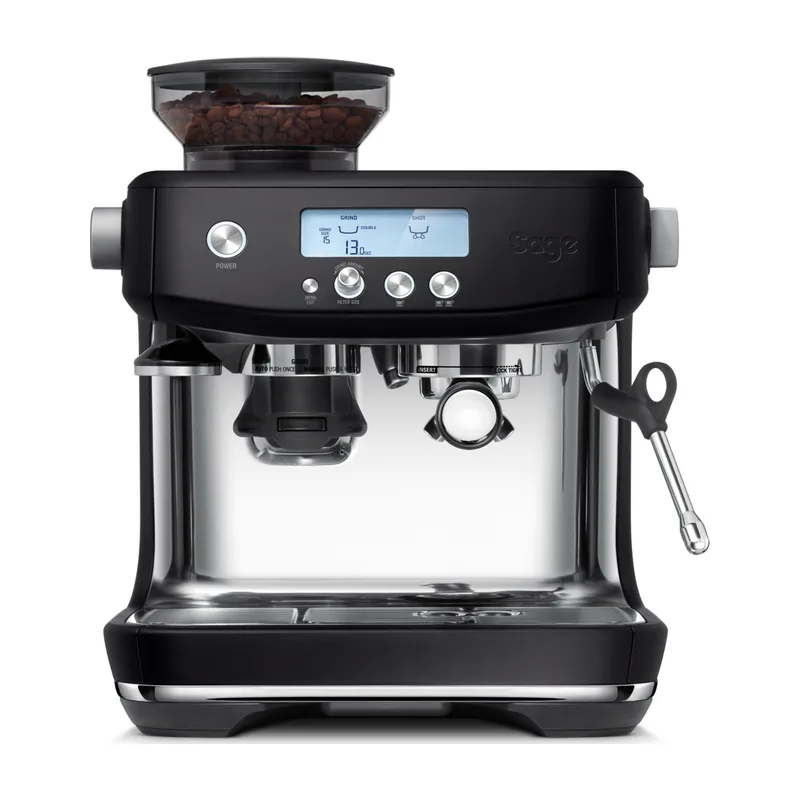
The Barista Pro and the Touch Impress share a lineage but not a job
On the retailer's figures the two machines look close: 15 bar pumps, 1680 W against 1700 W, a 1.9 litre tank against 2 litres, and a hopper of 250 g against 340 g according to Expert Reviews. The prices are not close, £579.95 against £1,199, and the difference in the job is what you are paying for.
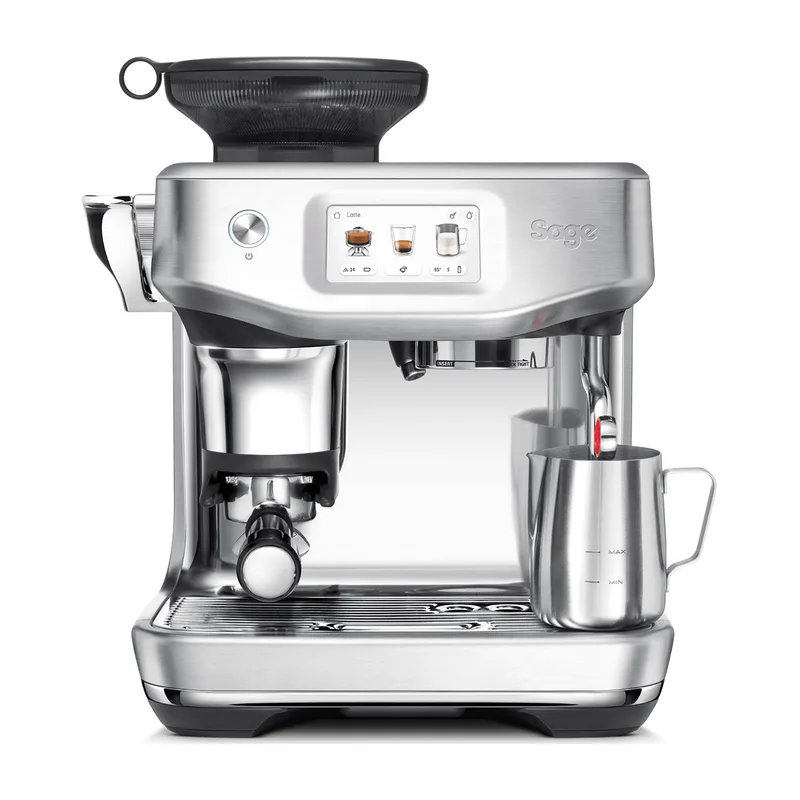
The Pro makes you the barista. Expert Reviews says it heats in under three seconds and that its steam is quick, but milk texture is yours to learn. The Touch Impress adds a 30-setting conical burr grinder with automatic or manual dosing, 14 presets with room for 6 custom ones, and the automatic milk system that Expert Reviews rated excellent. Expert Reviews also found its pump louder than the previous model's, and its touchscreen sluggish.
Think of a household where two people each drink two milky coffees on a weekday morning. On the Touch Impress each drink is a screen tap and a wait; on the Pro each is a dose, a tamp, a shot and a steaming session. Over a year that difference is large, and paying £619.05 extra for it can make sense. For someone who drinks one flat white at weekends, the Pro is the better buy and the Bambino is plausible if they already own a grinder.
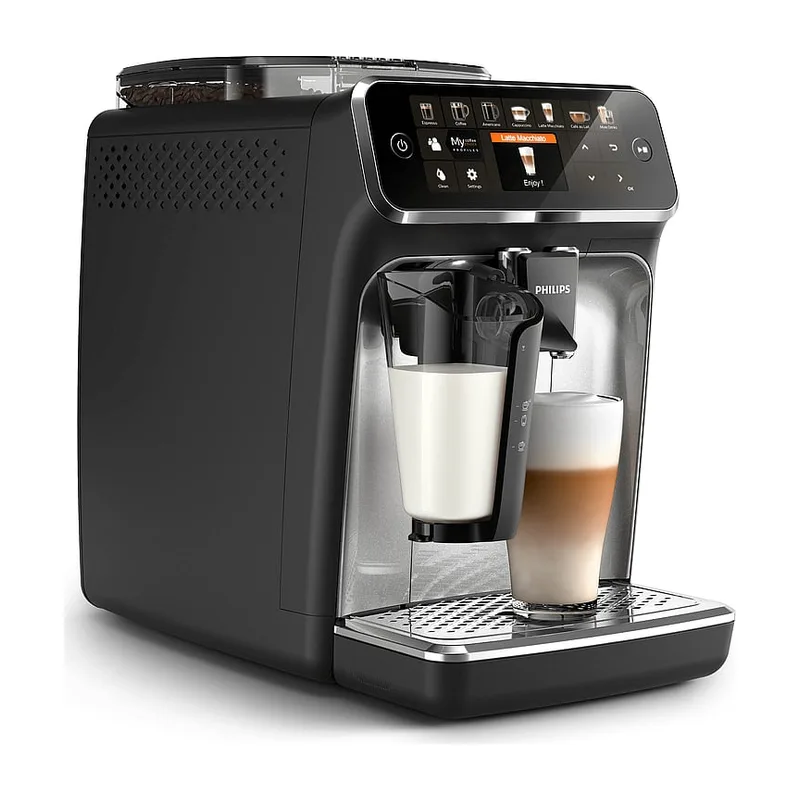
The two Philips machines are close on paper, so the price gap is the story
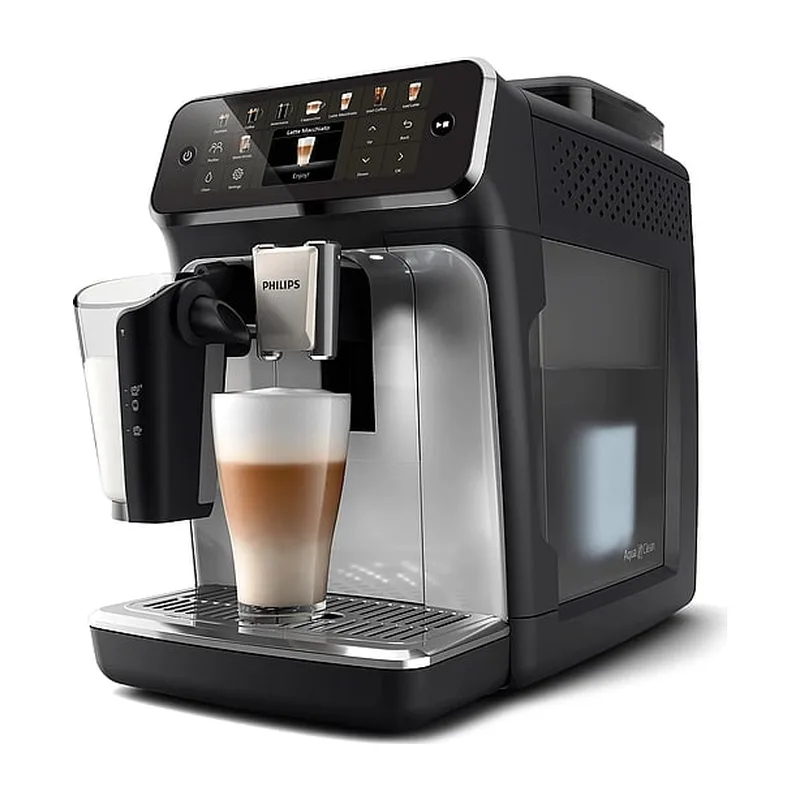
The 5400 and the 5500 share a 1.8 litre tank, 1500 W, a 15 bar pump, LatteGo and a two-year guarantee on John Lewis's pages. Heights are 48 cm and 47.3 cm. What differs is the headline: the 5400 lists four named drink types with 12 grind steps, while the 5500 advertises 20 hot and iced drinks and gives no grind steps.
That gap is £320 at the prices we saw. John Lewis cut the 5400 by £270 from £619.99, which is why the cheaper model sits so far below the other. If the discount ends, the two machines will be much closer, and the 5500's wider menu will look like better value. We recommend checking the current price of both on the day, because our placing of the 5400 above the 5500 rests partly on that gap.
The owner reviews point the same way, with 4.5 from 57 for the 5500 and 4.3 from 1,440 for the 5400 on its product page. Neither retailer page shows review text, so we cannot say whether owners of either machine complain about the milk or the noise.
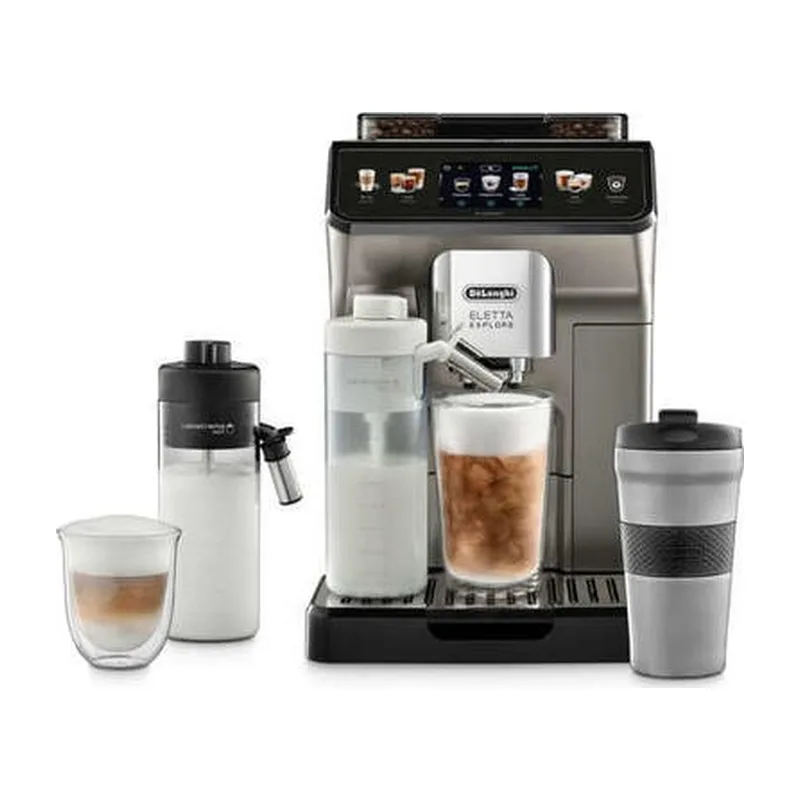
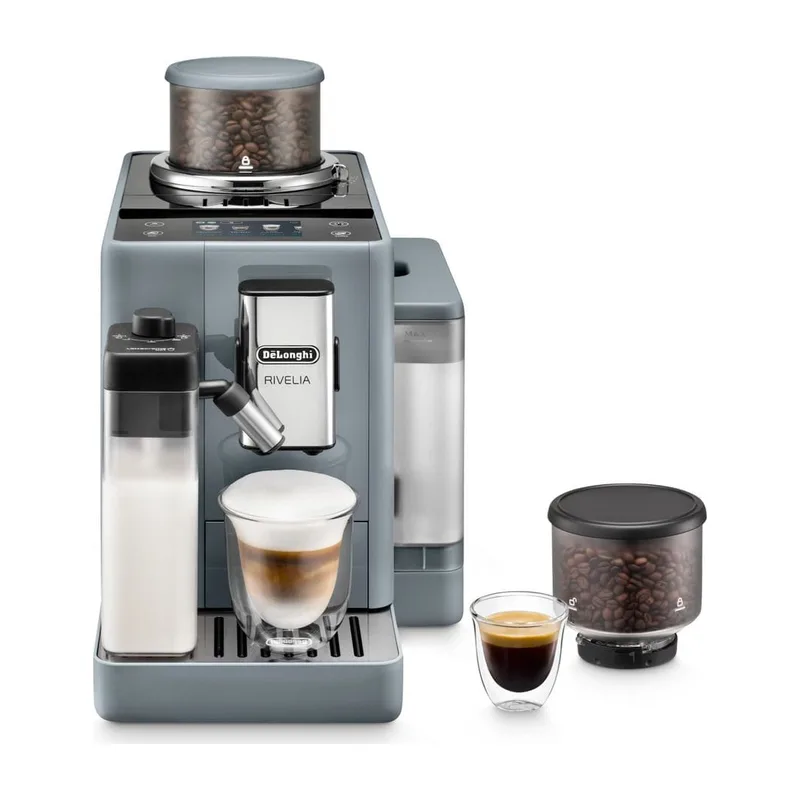
The Rivelia and the Eletta Explore differ by a tank, three drinks and £150
Both De'Longhi machines have a 19 bar pump and automatic milk, and both carry the same two-year guarantee at John Lewis. The Rivelia at £599.99 has a 1.4 litre tank, seven drink types and two interchangeable bean hoppers. The Eletta Explore at £749.99 has a 1.8 litre tank, 10 drink types and 50-plus one-touch recipes.
Owner reviews are close: 4.7 from 90 for the Rivelia and 4.9 from 69 for the Eletta Explore. The Eletta's higher average is on a smaller sample, so the two are effectively level. Choose the Rivelia if two people drink different beans, for example one caffeinated and one decaf, since the second hopper does exactly that. Choose the Eletta Explore if cold drinks matter, since cold brew is on its menu and not on the Rivelia's listed menu.
A T3 guide updated in July 2026 mentions both an Eletta Explore, saying it has no steam nozzle and that its carafe can be awkward, and a Rivelia in a short note. Neither carries a UK model number, so neither counts as evidence for the machines on this page.
Buying guide: choosing the right coffee machine
How much work you do matters more than the price tag
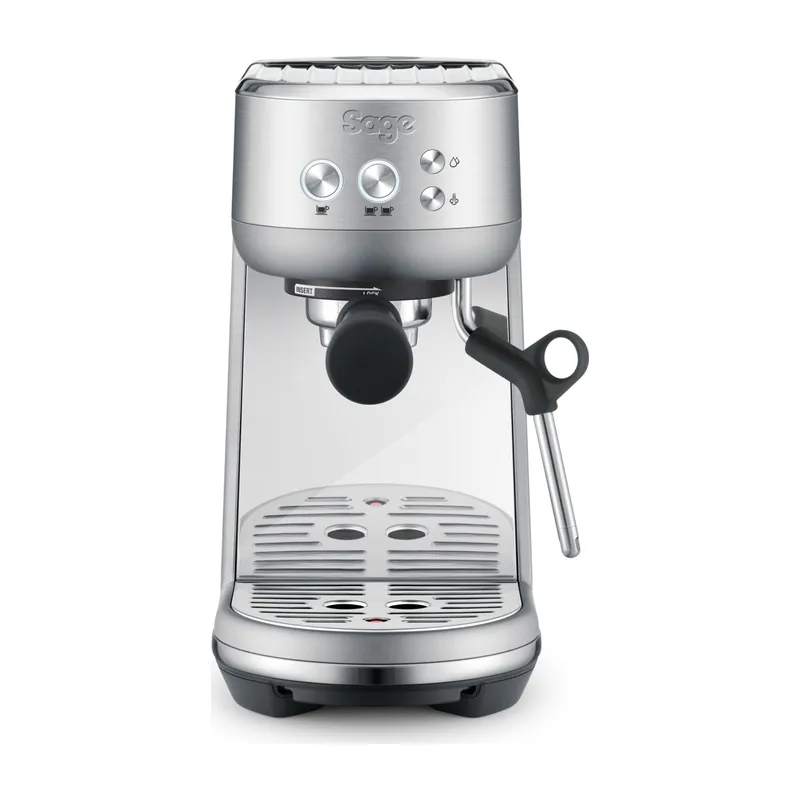
The seven machines split into three kinds of daily routine, and the routine is a better guide to satisfaction than the price. At one end the Bambino at £329 has no grinder at all, so you buy a separate one, dose the portafilter, tamp it and steam the milk yourself. Expert Reviews found it sensitive: a higher dose or finer grind made it choke into a slow drip, and it settled once the reviewer used about 17 g and a slightly coarser grind.
One step up, the Barista Pro at £579.95 grinds for you but leaves tamping and steaming in your hands. That suits someone who wants to learn latte art; it is the wrong machine for a household where one person wants a coffee in the morning rush and cannot spare the minutes. Its grind timer works in 0.5 second steps, and Expert Reviews found that too coarse for precise adjustment.
At the other end sit the one-touch machines, the Philips 5400 and 5500, the Rivelia and the Eletta Explore, plus the Touch Impress, which keeps a manual option but does the milk on its own. With these the routine is pressing a button and emptying trays. The trade-off is less control: Expert Reviews noted of the Touch Impress that manual steaming is awkward, and a one-touch machine gives you fewer ways to correct a poor shot than a Sage with a portafilter. Decide on the routine first and the shortlist shrinks to two or three machines.
The cheapest machine is not the cheapest purchase
A machine without a grinder needs a second purchase, and the page you are buying from will not mention it. The Bambino's £329 is £250.95 below the Barista Pro, yet the Pro's built-in grinder means the real gap narrows by whatever you spend on a grinder, a sum this page does not price because we did not verify one. Anyone who already owns a grinder gets the saving in full; anyone who does not should add a figure before comparing.
The one-touch machines handle this differently. The Philips 5400 at £349.99 grinds with 12 ceramic steps and froths with LatteGo, so it costs £20.99 more than the Bambino and needs nothing else except beans. Beans are the running cost that every option shares. At the 17 g dose Expert Reviews used on the Bambino, a 250 g bag makes 14 shots, and at the 19 g dose it reported for the Touch Impress it makes 13.
Discounts complicate the comparison. John Lewis shows the Philips 5400 at £349.99, marked down from £619.99, and the Barista Pro at £579.95, marked down from £729. A machine that costs £270 less this week can cost its full price next month, so compare current prices on the day you buy. The ranking on this page uses the prices we saw on 16 November 2026, and the price criterion carries 20 per cent of the weight.
If a machine you like is out of your budget, ask what you would actually give up rather than hunting for a discount. For some readers the answer is the touchscreen; for others it is the cold brew setting. Neither is needed to make a good flat white.
Milk is where the machines separate, and where Expert Reviews found the clearest faults
Espresso quality varies less between these machines than milk handling does. The Touch Impress offers presets for dairy, almond, oat and soy, a default of 65°C that can be changed from 45°C to 75°C in 5°C steps, and eight froth levels, according to Expert Reviews, which preferred the dairy froth for latte art but said oat also worked well. Nothing else in this group has a comparable written description of its milk handling.
The manual wands have their own habits. Expert Reviews says the Bambino spits hot water first, so you purge it into the drip tray, and that milk can splash when you pull the wand out because the machine has no solenoid valve to release pressure. The Barista Pro's steam arrives quickly, according to the same site, but producing microfoam is down to your technique. That takes practice, and practice costs milk.
The carafe systems on the Philips and De'Longhi machines solve this by hiding it, and they also hide the temperature. Expert Reviews, writing about the De'Longhi Magnifica Evo One Touch, a machine outside this selection, found its milk too hot and the temperature impossible to adjust, which made it taste less sweet than hand-frothed milk. We cannot say the Rivelia or Eletta Explore behave the same way, since neither retailer page gives a milk temperature. Check whether yours has an adjustable setting before buying.
If you already own a good machine and only want better froth, a separate frother is cheaper than replacing it, and our best milk frother comparison covers six models. For a machine bought as a package, test the carafe's cleaning routine against your patience.
A 48 cm machine will not fit under many wall cupboards
Size is the quietest source of returns. The Philips 5400 is 48 cm tall, the Philips 5500 47.3 cm and the Eletta Explore 49 cm on John Lewis's figure. The Barista Pro is 40.6 cm and the Touch Impress 41.5 cm, while the Rivelia is 38.5 cm and the Bambino 31 cm. Measure the gap under your cupboards, then add room to lift the lid or refill the bean hopper from above.
Width and depth matter as much. The Touch Impress is 36 cm wide and the Barista Pro 35.4 cm, wide enough that two cups and a knock box need worktop space beside them. The Rivelia is 24.5 cm wide and the Bambino 19.5 cm, which makes them the best fits for narrow galley kitchens. Depth is 32 cm on the Bambino and 49.3 cm on the Philips 5500, and John Lewis gives two conflicting depths for the Eletta Explore, 45 cm in one section and 55 cm in another. If your worktop is shallow, that discrepancy is reason enough to choose another machine or to ask the retailer.
Weight appeared on only one of the retailer pages we read: the Touch Impress at 10.97 kg. If you plan to move the machine between a cupboard and the worktop each day, the other six are an unknown, and it is worth asking before you buy.
Cleaning is a schedule, and the manuals set it, not us
Every machine here needs descaling and regular cleaning of the milk path, and the retailer pages say little about either. The most useful thing the data offers is how each manufacturer supports the habit. Expert Reviews says the Touch Impress ships with a backflush disc, cleaning and descaling products, a grinder brush and a steam wand tool, and its setup asks for a water hardness reading so the descaling reminders suit your tap water. The Bambino comes with a water filter that Expert Reviews says lasts about three months with regular use.
For the others we have only the descriptions. The Philips machines use LatteGo, which TechRadar's guide describes, for the 5500 series without a model number, as a two-part carafe that washes quickly. That claim is not verified for the EP5446/70 or EP5546/70 specifically. The Rivelia and Eletta Explore pages mention automatic milk but say nothing about how the carafe is cleaned.
A practical way to compare is to read the manual before buying: the manufacturers' own pages carry the cleaning and descaling intervals that retailer pages leave out. For the manual Sage machines, the portafilter and steam wand need wiping after every use. Expert Reviews notes the Bambino's portafilter drips after each shot, leaving wet pucks, which is a small mess but a daily one.
A 4.9 from 69 reviews tells you less than a 4.6 from 543
Star averages invite the wrong comparison. The Eletta Explore has the highest average here, 4.9 out of 5, but from 69 John Lewis reviews. The Barista Pro averages 4.6 from 543, the Touch Impress 4.5 from 276 and the Bambino 4.3 from 196. A handful of one-star reviews would move the Eletta's average noticeably, and the same number of them would barely register on the Pro's. That is why our owner-review score weighs the sample as well as the average.
The Philips 5400 shows how retailer data can mislead. Its product page says 4.3 from 1,440 reviews while the category listing said 4.5 from 178, and John Lewis does not explain the gap. We treat the larger sample as unverified and the smaller one as the safer figure, and say so on the product card. Neither page shows review text, so the reviews give a sentiment score without reasons.
The other limit is age. A Barista Pro review from 2021 and owner reviews gathered over several years describe the machine as it was sold then, and the retailer's current listing may carry changes. Where a review is old, we say so in the product card. Where a model has no independent review, the star average and sample are the evidence we have, and it is weaker than a written review that explains why. Read the reviews on the retailer page for the machine you shortlist, looking for repeated complaints about the milk system or noise.
Frequently asked questions
What is the best coffee machine in the UK?
Our top pick is the Sage Barista Touch Impress with Cold Extraction. It has the strongest independent evidence of the seven, with Expert Reviews rating the espresso and automatic milk highly in 2025, and 276 John Lewis reviews average 4.5 out of 5. It is also the dearest, so the Sage Barista Pro and the Philips 5400 are the sensible alternatives.
What is the best bean to cup coffee machine for a small budget?
The Philips 5400 EP5446/70 is the cheapest one-touch machine here at £349.99. It grinds with 12 steps and froths with LatteGo, but it has no independent review of this exact model, so it rests on John Lewis owner reviews. The Sage Bambino is cheaper still at £329, though it has no grinder and a manual steam wand.
Is a bean-to-cup machine better than a pod machine?
We have not compared pod machines here, so we cannot rank them. A bean-to-cup machine grinds beans for each drink, so you buy beans, empty a grounds container and descale from time to time. Which suits you depends on how much time you want to spend per cup and how much you drink.
How much should I spend on a coffee machine?
The seven machines here run from £329 to £1,199. Four of them cost between £579.95 and £749.99. Independent evidence exists only for the three Sage machines, so a higher price does not by itself guarantee a better cup, but in this group it buys a grinder and milk handling.
Do I need a separate grinder?
Only with the Sage Bambino, which has none according to Expert Reviews. The Barista Pro and Touch Impress have built-in grinders, and the Philips 5400 lists 12 ceramic grind steps. The retailer pages for the Rivelia, the Eletta Explore and the Philips 5500 give no grind steps, so check the manufacturer's specification.
Which coffee machine is best for oat milk?
The Touch Impress is the only one here with a written description of different milk types: Expert Reviews says it has presets for dairy, almond, oat and soy, that dairy gave better latte art and that oat also did well. Nothing on the other retailer pages mentions plant milks.
How quickly do these machines heat up?
Expert Reviews puts the Barista Pro at under three seconds and says the Bambino reaches brewing temperature in about three seconds, as claimed. The John Lewis pages for the other machines do not give a heat-up time, so we write not stated.
How often do I need to descale?
The retailer pages do not give an interval, so follow the manufacturer's manual. The Touch Impress asks for a water hardness reading at setup so that reminders suit your water, according to Expert Reviews, and the Bambino's water filter lasts about three months with regular use, according to the same review.
Is the Sage Barista Pro still worth buying after a 2021 review?
Yes, on the evidence available. The review is nearly five years old, but the machine is still sold under the SES878BSS code and 543 John Lewis reviews average 4.6 out of 5. The Touch Impress has a newer review, so take the Pro's age into account when comparing the two.
Why does John Lewis show different prices for the same machine?
Some John Lewis listings show a range, for example £550.00 to £579.95 for the Barista Pro, and a was price above the current one. We could not trace the lower end of a range to a specific offer, so we use the price on the product page: £579.95 for the Pro.