In depth: pregnancy pillows explained
What Expert Reviews' reviewer found, and the limits of one pregnancy
All the comfort verdicts on this page come from one Expert Reviews roundup, published on 14 October 2025. Its reviewer used five pregnancy pillows at different price points, and the ranking, the roundup says, is based on her experience. She also considered care, travel, returns and the choice of covers.
That makes it an honest but narrow source. One body, one bed, one pregnancy: her preference for firmer pillows early and softer ones later is useful, but your own may differ. Where her verdicts and the makers' descriptions agree, as on the Simba's coolness or the Dreamgenii's side sleeping shape, we give them most weight.
The roundup's ranking and ours largely agree. It placed the bbhugme first, the Nuliie second as best affordable, the Simba third as best cooling, and gave three stars each to the Silentnight and the Dreamgenii. We could not include the Nuliie because we could not verify a UK price and stock for it on the assessment date, and we added the Pillow Factory U shape, which the roundup did not cover.
The roundup also gives an idea of what is out there beyond our five. Its cheapest pillow was £27 and its dearest £159, and it noted that pregnancy pillows can cost less or more than that range. Our list runs from £19.99 to £189 because two prices have changed since the roundup was written.
bbhugme against Simba: £107 for adjustability and a better bump hug
These two are the most likely final choice for a buyer with a reasonable budget. On 14 November the bbhugme cost £189 and the Simba £81.75.
The bbhugme's case is support and flexibility. Expert Reviews found it supported back, bump, legs and head through the night, and its firmness can be changed as pregnancy progresses. The Simba's case is coolness, compact size and long term use as an ordinary body pillow.
The deciding question is your bump. If you are early in pregnancy and expect to need different support later, the bbhugme adapts. If you are buying late, in a warm season, for a small bed, the Simba's coolness and size count for more, but Expert Reviews' warning about pressure on the bladder is worth taking seriously.
A third option is to buy the Dreamgenii and save the difference. At £53.99, it costs less than a third of the bbhugme and is the only one of the three designed to double as a feeding pillow, but Expert Reviews rated its back comfort and cover quality lower than the other two.
Whichever you choose, buy from the maker if you want the return terms Expert Reviews describes, because they may differ through other shops.
Using a pregnancy pillow safely and keeping it clean
A pregnancy pillow is for you, not for a baby. After the birth, use it for your own support while feeding, and do not leave a baby to sleep on or against it; the NHS advises a clear, flat sleep space for babies.
Wash covers regularly, especially once the pillow is used for feeding. Dreamgenii and bbhugme sell spare covers, which makes this easier. For the two pillows that can be washed whole, the Silentnight and the Pillow Factory pillow, check the care label for temperature and drying.
Microbead and fibre fillings slowly lose loft with use. Plump fibre pillows daily, and reshape a microbead pillow like the bbhugme as the beads settle. If a pillow no longer supports you, a replacement or a refill is better than piling ordinary pillows around it.
Store the pillow dry and out of direct sun when you are not using it. If you plan to keep it for a second pregnancy, wash the cover and air the pillow before storing it in a breathable bag rather than a sealed plastic one.
Hand any pillow on with its cover washed and the care instructions, so the next person knows how to look after it.
The cheapest U shape against the cheapest pillow with a verdict
The Pillow Factory U shape and the Silentnight Body Support Pillow are the two pillows under £30, and they illustrate the choice between price and evidence. The Pillow Factory pillow costs £19.99, wraps around both sides of your body and can be machine washed and tumble dried, according to the maker.
The Silentnight costs £27, about £7 more, and has a three star verdict from Expert Reviews, which liked it for small budgets but found it suited back sleeping more than side sleeping. The Pillow Factory pillow has no independent verdict and one customer review in the maker's shop, rated one star.
The maker's description of the Pillow Factory pillow also includes claims about protecting the baby and relieving conditions such as sciatica and heartburn. No source we could use supports those claims, and we do not repeat them as benefits. A pillow is a comfort product; it is not a treatment.
For most budget buyers the Silentnight is the safer purchase because someone independent has slept on it. The Pillow Factory pillow makes sense if you specifically want a full U shape for the least money and have the bed space for it.
Buying guide: choosing the right pregnancy pillow
A pregnancy pillow is mostly about staying on your side, and some shapes do that better
The main reason people buy a pregnancy pillow is to sleep comfortably on their side as the bump grows. Expert Reviews' guide quotes a midwife, Beth Kitt, and the NHS on side sleeping in the third trimester, and that is the use most pillows here are designed around. A pillow that makes lying on your back comfortable is working against that aim.
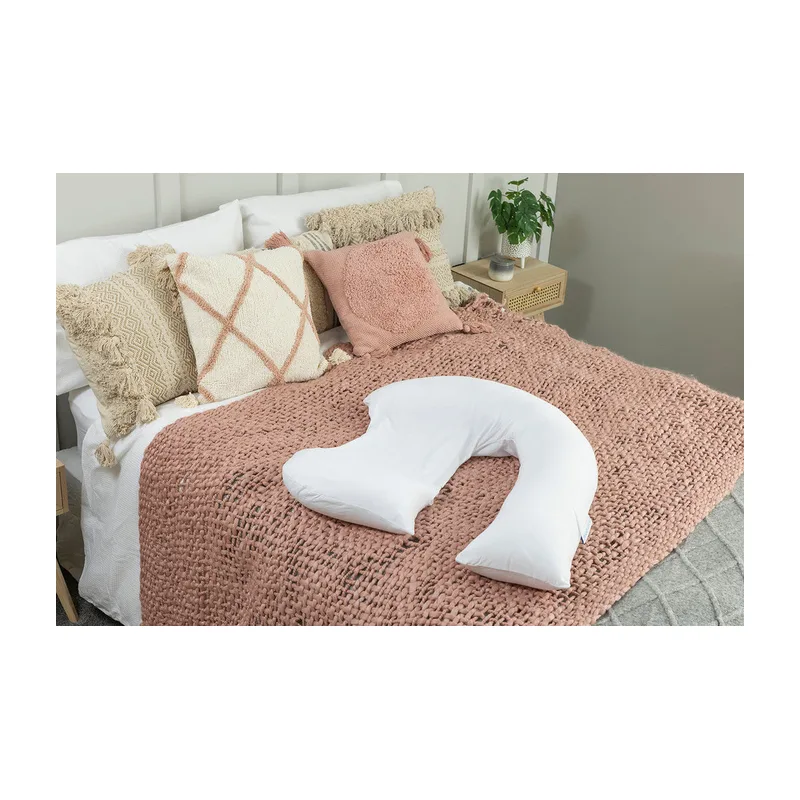
That is why the Silentnight, despite its low price and easy care, sits fourth. Expert Reviews' reviewer found it kept her on her back rather than her side. The Dreamgenii, by contrast, is shaped specifically to encourage left side sleeping, according to the maker, and Expert Reviews rated it well for keeping the reviewer on her side.
The bbhugme does both jobs: you can shape it to wedge behind your back and under your bump at the same time. The Simba, Expert Reviews found, only stops you rolling back if you wedge it behind you or add a second pillow.
If you naturally sleep on your side already, you may need less from the pillow than someone who keeps rolling onto their back. In that case comfort and size matter more than the shape's ability to hold you in place.
Partners notice the difference too. A pillow that holds you in place means less tossing and turning, which Expert Reviews' guide, quoting the same midwife, links to more settled sleep. The bbhugme's reviewer added that it could be adjusted in the night without disturbing anyone sharing the bed, a small detail that matters at 3 am.
If you tend to wake up on your back, try placing a firmer pillow such as the Simba wedged behind you and a softer one under the bump. That combination copies what the more expensive pillows do in one piece, and it costs nothing if you already own a couple of ordinary pillows.
A pillow between the knees is the simplest form of support, and every pillow here can be used that way. What the longer and shaped pillows add is support for the bump and back at the same time, so you do not have to arrange several pillows every night.
U shapes hug both sides; C shapes leave room for a partner
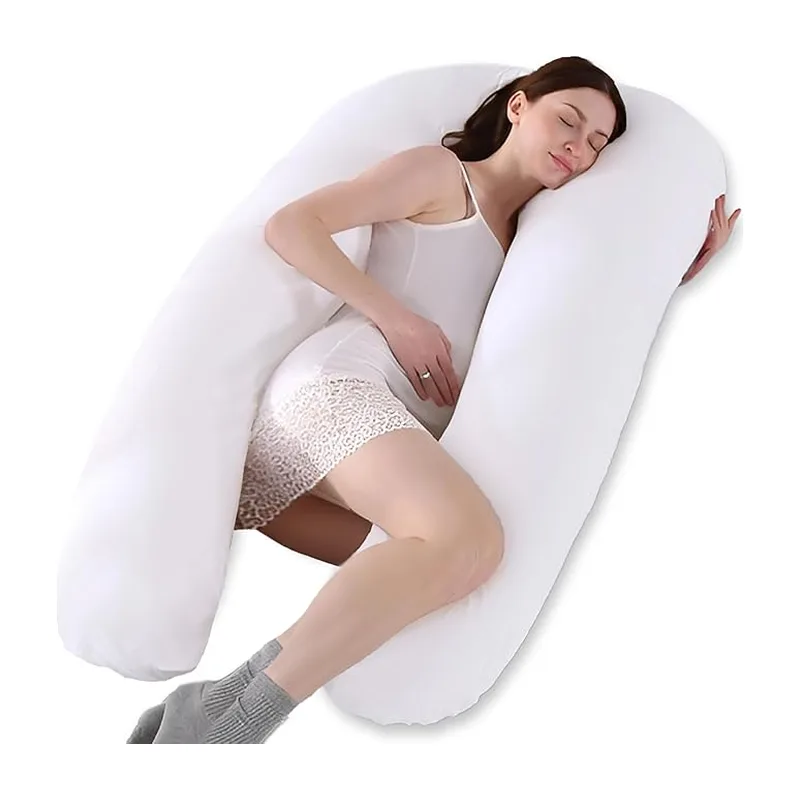
Expert Reviews' guide sets out the trade off clearly. A U shaped pillow wraps around your whole body, resting against your back and bump at once, so you can turn over without moving the pillow. A C shaped pillow curves around one side and is usually more flexible, which suits side lying and propping under the bump or between the knees.
The cost of a U shape is space. Pillow Factory describes its U shaped pillow as 12 ft long, and Expert Reviews noted that U shapes take up more bed space. In a standard double bed, that can leave a partner very little room.
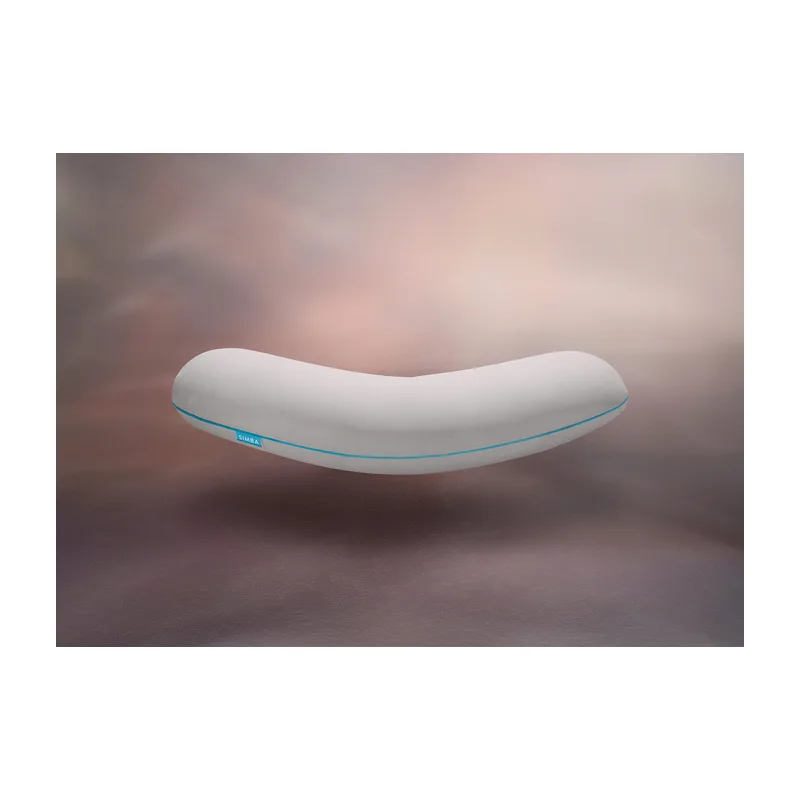
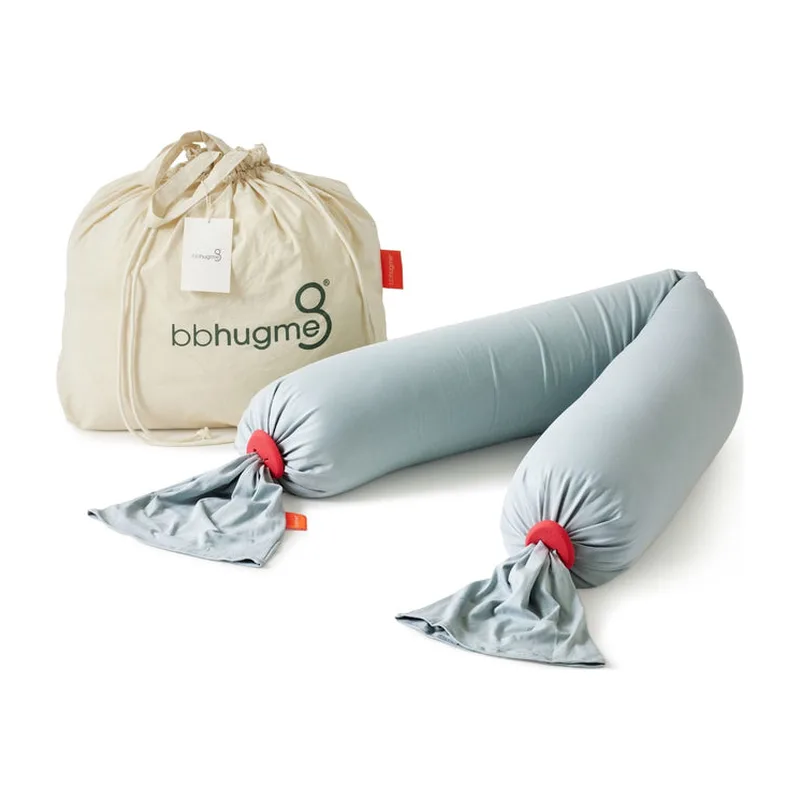
The bbhugme sits between the two. It is a long, slim pillow, 145 x 20 cm according to Expert Reviews, that can be twisted into a U, C, I or L. The Simba is a compact C at 120 x 35 cm.
Measure your bed before you choose. A king size bed copes with a U shape; a double shared with a partner usually does better with a C shape or a flexible pillow.
A C shape also travels better. Expert Reviews noted that the Nuliie U shape, its budget pick, does not come with a proper travel bag and is not ideal for smaller beds, while the bbhugme comes with a cotton tote. If you will spend nights away, at relatives or in hospital, a smaller or bagged pillow is far easier.
Set up time differs too. Expert Reviews found a vacuum packed U shape took two days to reach full size. Pillows that arrive compressed need time to recover before they give the support you paid for, so do not judge them on the first night.
Microbeads, fibre and foam feel different, and the difference changes as your bump grows
The bbhugme is filled with expanded polystyrene microbeads, which shift to fill gaps around the body. The Simba uses combed polyester fibres, the Silentnight hollowfibre. Dreamgenii and Pillow Factory do not state the filling on their product pages.
Expert Reviews' reviewer found firmer pillows better earlier in her pregnancy and softer support around the bump better later on. That is the strongest argument for the bbhugme's adjustable firmness: one pillow can change with you instead of feeling right for only a few weeks.
Firmness has a downside in late pregnancy. The reviewer found the firm Simba pressed into the bladder, a common problem she attributed to firmer pregnancy pillows. If you are buying near the end of pregnancy, a softer pillow is the safer guess.
Microbeads can be noisy for some people and fibre fillings can flatten with use. None of the sources we could use measured either, so treat the filling as a guide to the feel rather than to durability.
Weight is a side effect of filling. Microbeads and dense fibre make a pillow heavier to move around a bed, which matters when you are tired and heavily pregnant. None of the makers here state a weight, so the best guide is the reviewer's comments on how easily the pillow could be repositioned at night.
Allergies are another reason to check. All the fillings here are synthetic, so none contain feathers, but if you react to particular fabrics, the cover is the part touching your skin: cotton jersey on the Dreamgenii, cotton and spandex on the bbhugme, polycotton on the Pillow Factory pillow and microfibre on the Silentnight.
A simple check when the pillow arrives: lie on your side with it in place for ten minutes before you go to sleep. If your top knee and your bump both feel supported and your spine feels straight, the firmness is about right. If the pillow pushes into your bump, it is too firm or too high for you at this stage.
Being able to wash the whole pillow matters more than you might expect
A pregnancy pillow gets heavy use for months, and sometimes beyond, as a feeding pillow. Every pillow here has a washable cover, but only two can be washed whole: the Silentnight, which the maker says can go in the washing machine, and the Pillow Factory pillow, whose polycotton outer can be machine washed and tumble dried.
The Dreamgenii's covers are machine washable and replaceable, but the pillow itself is not, according to Dreamgenii. The bbhugme's and Simba's covers are machine washable according to Expert Reviews; the fillings are not.
Spare covers solve most of the problem. bbhugme sells extra covers and Dreamgenii sells replacements, so you can wash one while using the other. If you expect spills during feeding, budget for a second cover with either.
Easy care alone does not make a good pillow. The Silentnight and the Pillow Factory pillow lead on washing but rank lower on support, so weigh how often you will wash against how well the pillow does its main job.
Drying time is the hidden cost of washing a whole pillow. A large fibre pillow can take a long time to dry fully, and using it damp invites mould. Pillow Factory says its polycotton outer can be tumble dried; for the Silentnight, check the care label before putting it in a dryer.
For most people, a washable cover plus a pillow protector or spare cover is the practical answer. It keeps the pillow itself clean and avoids the problem of a huge pillow taking up the washing machine and the airer for a day.
You can spend £19.99 or £189, and the gap buys adjustability more than comfort
Prices here run from £19.99 for the Pillow Factory U shape to £189 for the bbhugme. Expert Reviews' own roundup ranged from £27 to £159 when it was written, and it asked the same question: save or splurge?
What the extra money buys at the top is adjustability: firmness you can change and a shape you can rebuild. Below that, the Simba at £81.75 buys a cooler cover and a body pillow you can keep using, and the Dreamgenii at £53.99 buys a dedicated side sleeping shape and a feeding pillow.
At the bottom, the Silentnight at £27 is a capable general body pillow with an independent verdict, and the Pillow Factory pillow is the cheapest way to get a full U shape, without any published evidence of how it performs.
If money is tight, a cheap pillow plus a couple of ordinary pillows can do much of the same job. Expert Reviews' guide notes that some people use normal pillows to support side sleeping, while dedicated pregnancy pillows offer more support in one piece.
Cost per night is a useful way to frame the decision. Used every night for the 12 weeks of the third trimester, the bbhugme costs about £2.25 a night, the Simba under £1, the Dreamgenii about 64p and the Silentnight about 32p. If you keep using the pillow after the birth, those figures fall further.
Second hand is an option for the more expensive pillows, provided the cover can be washed or replaced. bbhugme and Dreamgenii both sell spare covers, which makes a used pillow easier to freshen up.
Whatever you spend, check the size against your bed before ordering, because a pillow that does not fit is the most common reason for a disappointing buy.
A pillow you can keep using after the birth is worth more
Expert Reviews' guide points out that a pregnancy pillow can be used after the birth for support while breast or bottle feeding and during recovery. Two pillows here are designed with that in mind. Dreamgenii sells its pillow as a pregnancy, support and feeding pillow, and the bbhugme can be reshaped for different uses.
The Simba is a body pillow first and a pregnancy pillow second, which Expert Reviews saw as a plus: something the whole household can use long term. The Silentnight is also sold as a general body support pillow for lounging and propping.
A full U shape is the hardest to reuse. It is large and suits one purpose, which is why the Pillow Factory pillow, despite its price, offers less after the birth than the smaller pillows.
If you are deciding between two pillows, ask which one you would still use a year from now. The extra cost of the Simba over the Dreamgenii, or the Dreamgenii over the Silentnight, looks different spread over two years than over three months.
Feeding support is a different job from sleep support. A feeding pillow needs to sit firmly around your waist and hold the baby at the right height, which a long body pillow does not always do. The Dreamgenii is designed for both, so it is the safest choice if you want one pillow for pregnancy and feeding.
If you plan to use a separate feeding pillow anyway, the Simba or the Silentnight make more sense as long term body pillows, for propping up in bed or supporting a sore back on the sofa.
Cool covers help most if your due date is in summer
Overheating at night is common in late pregnancy, and the pillow you hug all night adds to it. Expert Reviews found the Simba Body Pillow the best of its roundup at keeping hot and sweaty nights at bay, which it put down to Simba's Stratos cool touch cover.
The other pillows here make no specific cooling claim on the pages we read, apart from the jersey covers on the bbhugme and Dreamgenii, which are cotton based. Cotton breathes better than synthetic fleece, but no source measured temperature for these pillows.
Timing matters. If your third trimester falls between June and September, cooling is worth paying for; in winter, a soft jersey or microfibre cover may feel more welcome. Expert Reviews' budget pick, the Nuliie, comes with a choice of a velvet style cover or a cooling fabric, an example of how makers handle the same question.
A cotton pillowcase over a synthetic cover is a cheap fix if you already own a pillow that feels too warm.
Room temperature matters as much as the pillow. A pillow can only do so much in a warm bedroom; a lighter duvet and a cooler room have a bigger effect. Treat a cooling cover as a help at the margins rather than a fix.
If you buy a pillow with a cooling cover, keep the original cover clean. Covers designed to feel cool usually rely on the fabric's surface, and washing them as the maker recommends keeps that feel for longer.
Returns matter because comfort is personal
No review can tell you how a pillow will suit your body, your bed and the stage of pregnancy you are at. That makes the return terms part of the value. Expert Reviews lists 30 days for both the bbhugme, with a one year warranty when bought directly, and the Simba, with no need for the original packaging.
Pillow Factory offers a satisfaction guarantee with a full refund if you contact it, according to its product page, but does not state a time limit. Dreamgenii and Silentnight do not state a return period on the product pages we read.
Bedding is often excluded from returns once used, for hygiene reasons, so read the terms before you sleep on a pillow you are not sure about. A 30 day window only helps if used pillows are covered.
If you are buying early in pregnancy, the window may close before you know whether the pillow suits your bump later on. That is another reason the adjustable bbhugme scores well: if it feels wrong, you can change it instead of returning it.
Keep the packaging until you are sure, even if a maker does not require it. Simba does not need the original packaging for a return, according to Expert Reviews, but it is easier to send back a bulky pillow in the bag it came in.
Ask about returns before you buy if the product page is silent. A quick question to Dreamgenii or Silentnight costs nothing and avoids a disappointment with a pillow you cannot send back.